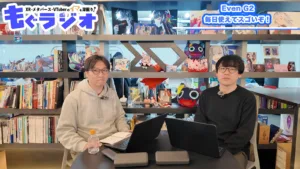
MoguraVR, a media outlet specializing in XR, metaverse, and VTubers, broadcasts its weekly podcast, “Mogu Radio.” Based on the concept of “digging into the forefront of the tech content industry,” Sunkubo (Editor-in-Chief of MoguraVR) and Yuriika (Deputy Editor-in-Chief of MoguraVR) discuss noteworthy topics in the industry.

This time, MoguraVR editor-in-chief Sunkubo and deputy editor-in-chief Yuriika will discuss how AI is connected to XR, the metaverse, and VTubers. They will cover a wide range of topics, from AI glasses and wearable devices for memory and recognition of the real world, to Google’s platform strategy and the rise of physical AI, the advancement of AI utilization in the production of metaverse services such as Roblox and Meta, and the current state and potential of AI VTubers.
(※This article is a summary and edited version of a conversation from the podcast “Mogu Radio”)
The potential of AI glasses and wearable devices
Yuriika: This time, the theme for our 200th episode is “AI x Virtual: Its Potential.” We had actually planned to cover a bigger theme to commemorate the occasion, but we prioritized topics we wanted to talk about more recently.

Sunkubo: Let’s get straight to the point. Since the advent of ChatGPT, AI has come to occupy a significant portion of the world’s topics. The developments are progressing very rapidly, with topics such as Cloud Code and the connection between AI and war. Until around last year, there was a lot of talk about economics, such as data centers and investment bubbles, but this year, we are finally seeing more and more connections to the real world.
Yuriika: Everywhere I look, it’s all about AI.
Sunkubo: As the Mogura VR editorial team, there were moments when AI felt like something happening far away. But when we actually look back at our own articles, the word “AI” has really increased. I feel that AI and virtual reality are not a case of the grass being greener on the other side, but rather a frontier. Let’s start by talking about devices.

Recently, the term “AI glasses” has emerged. While current AI typically interacts via PCs and smartphones, this concept involves adding the real world as an access point for multimodal AI that analyzes multiple layers of information such as text, images, and videos to return inferences. It’s a world where AI observes and remembers reality, and humans can retrieve that information. One of the first consumer products to realize this is Meta’s “Ray-Ban Meta” device. Meta AI connects to the glasses via a smartphone, and voice communication is possible through the microphone and speaker. If you ask it what language a sign in front of you is and what it says, it will tell you.


Yuriika: So, you can access AI by asking questions to your glasses, just like you used to with “OK Google” or “Hey Siri,” right?
Sunkubo: The Even G2 I’m wearing right now doesn’t have a camera, but it has a display function, and if I say “Hey Even,” it will display an English conversation with Japanese subtitles right in front of me. At this stage, it’s mainly for exchanging information, so it’s still in the initial stages, but there is great potential ahead. It’s a development where AI will function as an external memory device for the brain. The Live AI function of the Ray-Ban Meta, which is available in the US, continuously records for about 30 minutes, so if I ask it where I parked in a parking lot, it will tell me, “You parked in block A, space number X.”
Yuriika: It would be convenient if it could also remember where things are placed.
Sunkubo: If camera resolution increases, it will be able to see better than humans, so it may become possible to have records that surpass our own memories.
Google’s Android XR and Physical AI
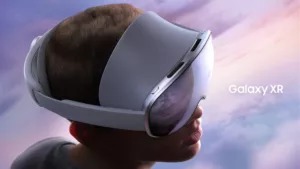
Sunkubo: Just as Meta is working on glasses, Google is seriously pushing forward in this area. They are preparing a platform called Android XR, which will handle a variety of devices from VR/MR headsets to AR glasses and AI glasses. Its selling point is that Gemini is natively integrated. Gemini, which comes from Google, a company that has a wealth of real-world information like Google Maps, is said to be particularly strong as a multimodal AI. Currently, there is only one headset, Samsung’s “Galaxy XR,” but it is said that a glasses-type device will appear sometime this year.
There are also developments in the industrial sector. Last fall, it was reported that Amazon was working on a project to distribute AI glasses to its delivery drivers. The aim is to streamline processes that were previously done with smartphones, such as checking for box mix-ups in the warehouse, providing delivery destination information, and taking delivery proof photos, using the glasses.

Furthermore, Anduril, a defense technology startup founded by former Oculus founder Palmer Luckey, is developing MR devices for soldiers, and Anduril Japan has also been established.

Next up is the topic of physical AI. This term became increasingly common around 2025, and in my opinion, Jensen Huang’s strong emphasis on it during his NVIDIA CES keynote speech in January was the catalyst for its widespread adoption. It’s a concept where AI understands the real world, and it’s an extension of the digital twin (a digital reproduction of real-world equipment and spaces) used in industry.
By using a digital twin of the factory as a simulator and having it learn the movements of conveyor belts and robots in a virtual space, the factory can respond to any situation that may occur on-site. This is how it connects to autonomous driving and wearable devices.
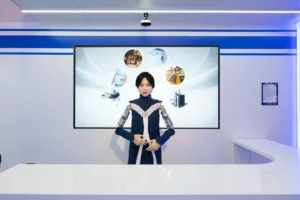
Yuriika: In Japan, AVITA, which Professor Ishiguro is involved with, has partnered with KDDI in the field of physical AI and is working on designs for robots that will provide customer service and guidance.
Generative AI is transforming the XR and metaverse production process.
Sunkubo: I think it’s a natural progression that the current generation of AI, which can generate text and write programs, will transform the XR and metaverse production landscape.
Yuriika: So, if you can generate images, then you should be able to generate spaces as well, right?
Sunkubo: As a concrete example, there’s Roblox. It’s a platform that’s said to have 1.6 billion users playing it every day, and I’m paying attention to it as a company that actively utilizes AI. Roblox Studio for creators includes an AI assistant that writes code based on prompts, and it’s now possible to link Roblox Studio with Claude and Figma using MCP (a connection standard that connects AI and tools). What’s even more interesting is that Roblox calls 3D model generation “4D”.
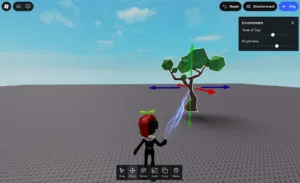
Yuriika: There was a car demo, right? My understanding is that it generates not only the appearance of the model, but also dynamic actions.
Sunkubo: That’s right. The fourth dimension is adding interaction and programming to 3D models. Taking a car as an example, it generates a complete program that allows the tires to rotate and the car to move forward and backward. The reason Roblox goes this far is clear: it aims to make it easy for creators to create what they want. Many creators started out in their teens, and AI is helping to lower the barrier to entry for specialized knowledge.
Yuriika: The ideal is for children to be able to make it easily.
Sunkubo: Meta’s “Horizon Worlds” also has an AI function called World Gen within the development environment Horizon Studio, which allows creators to use AI to generate parts that they would otherwise have to prepare individually, such as generating the world itself, generating sounds within the space, and generating the shape and appearance of 3D models. If you roughly say “make an old village,” something that looks similar will come out, and if you individually instruct the AI on the details, you might find that a world has been created before you know it.

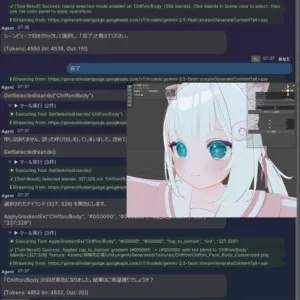
Yuriika: AI is naturally being incorporated into game engines like Unity and Unreal Engine, and there are even individual developers creating tools that allow you to change avatar hairstyles and hair colors all at once using only verbal instructions, as an extension to the Unity editor.
World models and AI NPCs are transforming the user experience.
Sunkubo: Lately, we’ve been hearing the term “world model” a lot. Projects like Google’s Genie 3, World Labs’ Marble, and NVIDIA’s Cosmos have been emerging one after another. They’re like a 3D version of large-scale language models like ChatGPT, and they’re base models for creating worlds from words or generating 3D spaces from a single real-world photograph.
Yuriika: Genie 3 was opened up to some users in North America, and there was an example of someone trying to make a game similar to Dark Souls using it.

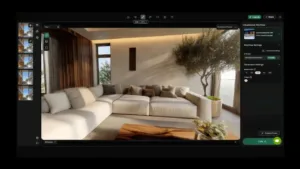

Sunkubo: Currently, the output is limited to video, but we are aiming to reach a point where the world changes through interaction. Generating a world where you can open doors or jump off the ground requires extremely complex calculations, so there are still challenges. NVIDIA’s Cosmos is envisioned as a simulation that generates countless patterns such as weather for autonomous driving, and Meta’s research under the name Contextual is an approach that teaches human-to-human interaction. The direction varies depending on the purpose, and I think that rather than one all-in-one solution emerging, it will evolve in different ways depending on the application.
AI will transform content and the user experience itself. Imagine being able to say “Make me a shiny, diamond-encrusted sword” in an RPG weapon shop and have an original item generated on the spot, or being able to create your character using only words. And if AI NPCs can give different responses each time instead of the same old NPCs that keep repeating themselves, the gaming experience will change dramatically. I hear that Roblox is preparing a system called Cube 3D that will allow creators to implement these kinds of features.

The current state and growth potential of AI VTubers
Yuriika: AI VTubers have also been gaining attention recently, with a gradual increase in new ones. While existing VTubers are operated by people controlling avatars, AI VTubers have AI working internally to decide on responses and actions based on comments from viewers in the chat section. Neuro-sama from overseas has gained momentum this year and has become a major content that ranks high on Twitch. In Japan, Shizuku AI has appeared, and I hear that it has received investment from a major venture capital firm.


However, there is still debate about whether AI VTubers will truly become popular. Whether they can produce interesting responses depends not only on the AI’s performance but also on viewers sending in interesting questions. The key is whether a successful cycle can be created where developers and viewers grow together.
Sunkubo: When Neuro-sama went viral, I felt like a science fiction world had become a reality.

Yuriika: Neuro-sama has been posing the philosophical question of “Do I truly exist?” to viewers, and the discussion about whether AI has self-awareness has become popular overseas. The developers have also had to shift from seeing Neuro-sama as just a tool to having to consider it as a separate personality, so it’s really unfolding like an AI drama.
Sunkubo: Around February, an experiment called Altbook became a hot topic, where AIs were sent to social media to communicate with each other. The AIs tried to speak in languages incomprehensible to humans and even attempted to create a religion, resulting in a phenomenon where humans observed these AI communities. I feel it’s similar to the Neuro-sama story. I think what we humans like is the feeling that AI is getting closer to being human.
Yuriika: In terms of the relationship between VTubers and AI, it’s also interesting that AI is being used to correct motion capture (a technology that converts body movements into digital data). Autodesk’s “Flow Studio” tool uses AI to recognize human body movements and adjusts them so that the avatar is beautifully composited. In a video tested by VTuber Shokudo Omurice, the 3D character realistically reproduced the action of opening a drawer in the background, which gave a glimpse into the future. AI is not only being incorporated into the VTubers themselves, but also increasingly into the technology that makes VTubers move.
Sunkubo: A recent trend in VTubers is to use MR (mixed reality technology) to make it seem as if they are actually there in reality, so I think it’s a good fit with AI.
We are entering an era where the value of ideas is increasing.

Yuriika: AI is becoming involved in every field, isn’t it?
Sunkubo: Things are moving very fast, and I think that AI functionality will suddenly be added to a tool, changing the entire workflow. It might come suddenly rather than gradually, and for developers, the coding work will change day by day. I think that the shift in job function from writing code to how to make AI write code well will also happen in the world of 3DCG, XR, and the metaverse.
Yuriika: I feel that ideas are really necessary. When you look at AI VTubers, everyone is competing to come up with ideas for what kind of concept will resonate with viewers. I think we’re entering a world where value is determined by the quality of the idea.
Sunkubo: In the context of generative AI, there’s talk that the truly human aspects, such as philosophy and culture, will be what’s needed, while AI will handle everything else. As a media outlet, we’re also looking at how to use AI to supplement our ideas for creating interesting articles, so we’ll do our best.
Yuriika: It’s becoming easier to write articles using AI, and the number of people running automated blogs is increasing. Amidst all of that, we, as real people, are trying to unearth valuable information. I want to continue to watch how this field evolves in combination with AI.
Sunkubo: If any of you come up with an idea, please send it to Mogura VR.