
Cover Corporation, the company that operates the VTuber group “Hololive,” has been working on a metaverse project called “HoloEarth.” While the project has developed significantly since its launch, with the release of new areas and other improvements, the sudden announcement that the service will end on June 28, 2026, has left fans and market participants bewildered.
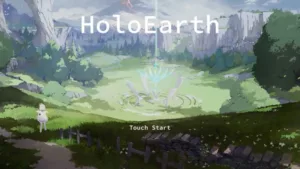
Although the service had a short operating period of about one year since the official release of version 1.0.0, the project that initiated it, “Hololive Alternative,” had actually started in 2021, indicating that it was a project that had been under development for many years. The magnitude of the impact of this service termination is immeasurable, with Cover Corporation recording an extraordinary loss of approximately 3.2 billion yen.

MoguLive conducted an interview with Cover Corporation about HoloEarth in its early stages, and has continued to follow HoloEarth through experience reports and other means. In this article, we will unravel the background behind the end of HoloEarth, based on the articles we have published so far.
Tracing the history of Holo-Earth

The project that started it all, “Hololive Alternative,” was announced in February 2021 as a project to create an alternate world that would unfold “what if” stories for Hololive’s VTubers. This project saw the release of various media mix works, including anime PVs and the manga “Yamato Shinsou Kaiitan,” but the main project that progressed was the metaverse project “HoloEarth,” which was announced in October 2021.


“HoloEarth” was a metaverse that aimed to allow Hololive VTubers and fans to experience virtual space together, and the communication lobby and sandbox games that form the basis of the current HoloEarth were planned at this stage. At that time, “metaverse” was a major topic of discussion in society and was spreading rapidly, and the interview suggests that HoloEarth was also steering in that direction.


The prototype was also unveiled during VTuber live streams, showcasing a vast space where players can enjoy crafting. In an interview, the person in charge stated, “To give you an example from previous titles, it will be similar in concept to games like ‘Minecraft’ and ‘ARK: Survival Evolved’.” Indeed, the gameplay, which involves fighting monsters, collecting materials, and completing missions to enhance the crafting elements, was strongly emphasized, indicating that the development was influenced by the gaming trends popular within Hololive at the time.
The interview is available here.
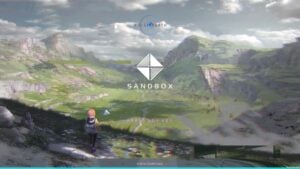
Furthermore, even before the sandbox was implemented, a virtual live performance by Hololive VTubers took place. “ProtoLive,” aimed at verifying HoloEarth’s system operationality and server load, was held in December 2022, allowing attendees to watch AZKi and Calliope Mori perform live. User avatars, though simple, could move freely, and the tracking of the VTubers was properly reflected in the live performance, giving a sense of future potential.


Subsequently, in November 2023, the “Simulation Room,” where players can experience a portion of the sandbox game, was implemented, followed by “Alternative City,” where players can purchase and change their fashion, in May 2024. While features for rich interaction between avatars as a metaverse are not yet fully developed, it gave the impression that the developers had shown a direction for the kind of space they want to create in the future.
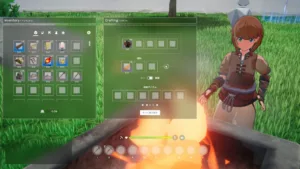


Then, in December 2024, the long-awaited large-scale open field was implemented. This mode allows players to freely explore and craft in a vast plain, and the graphics and available features seem to have been significantly improved since its initial announcement. In addition to providing a satisfying gameplay experience, it also features unique systems such as Protect Cubes and Observation Beacons, demonstrating the meticulous craftsmanship despite being a free game.
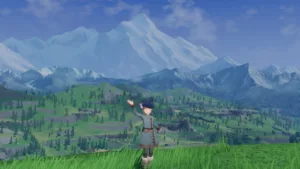

In April 2025, a marketplace where users can sell items was implemented in HoloEarth and officially released as ver. 1.0.0. Furthermore, the user-generated content (UGC) element, allowing users to create and sell their own items, had been mentioned in the interview, and its realization came after approximately three years.
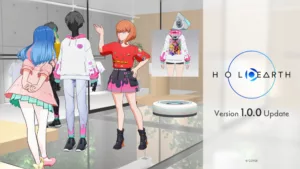

In summary, HoloEarth can be described as a platform that has evolved and developed its functions in each of its directions: “sandbox game,” “VTuber live,” and “creator market.” However, looking at recent update information, it seems that the focus has been more on enriching the marketplace and the space where avatars can interact with each other, rather than updating the sandbox game elements.
The current state of HoloEarth and the problems it reveals.
HoloEarth has been actively updated since version 1.0.0. New areas have been released, including the new entrance “Focal Square,” as well as “Demon World Geo,” “Fortress City Westa,” “Kyonomiyako,” and “Celestial Beach.” New characters, furniture, and face tracking functionality have also been added. What’s surprising is the animated opening sequence at startup.

(Demon World Geo)

(Kyonomiyako)

(Fortified city of Wester)

(Celestial Beach)
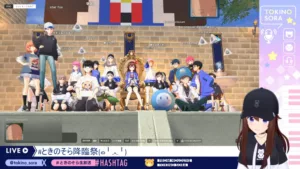
Measures have also been taken to attract users. Starting with Sora Tokino, Hololive VTubers, including those from EN, have descended upon HoloEarth and appeared, enabling direct interaction with fans. It has also been actively used for simultaneous viewing events and live concerts held on HoloEarth, emphasizing that it is Hololive’s metaverse.
Looking back at the information so far, you might wonder why the service ended. In reality, while the individual elements of HoloEarth were undoubtedly unfinished, they were undoubtedly made with high quality, and it had the unique strength of allowing users to meet Hololive VTubers. Compared to the numerous domestic metaverses that launched around the same time, it gives the impression of being far superior in scale and completeness.
However, after the service termination announcement, I explored the new areas, but I didn’t encounter many other users, and I couldn’t shake the impression that it was deserted. It might be unavoidable since it was a weekday during the daytime after the service termination announcement, but I honestly wish there were more people around. New elements have been added to the simulation room, but it doesn’t feel as surprising or novel as when the open field was first released.
According to Tanigo Motoaki, President and CEO of Cover Corporation, the reason for the service’s termination lay in the way HoloEarth was deployed.
So why did HoloEarth choose to shut down? Tanigo analyzes that the reason lay in “HoloEarth’s unique development method.” “They incorporated various elements, such as holding live events and developing games. If they had focused solely on live events, there might have been potential, but they expanded the business too much.”
In fact, there was a discussion within the company last year about whether or not to continue the service, and although they attempted to revamp it by focusing on the live streaming function, it did not yield the desired results. Another issue cited was that the creation of two options for the talent—the existing streaming app (Hololive) and HoloEarth—resulted in a burden.
In addition, he expressed remorse as a business leader, saying, “Despite it being an important project, I wasn’t in a position to commit to it to that extent. For a project like this, which was crucial to the company’s future, I should have been the one in charge of the project.” At the IR meeting held on the same day, it was also announced that the CEO and CTO would be voluntarily returning their executive compensation.
From an article about Cover Corporation’s financial results briefing for the fiscal year ending March 2026.

Looking back at HoloEarth with the above in mind, the extremely complex structure of this service becomes clear. It offers numerous elements such as a sandbox, live events, fashion, and a creator marketplace, but it appears that the multifaceted approach placed a heavy burden on the team, preventing them from focusing on each element individually. Considering that the originally planned development period was two years, it seems that the burden was far greater than anticipated.
Furthermore, while fans gather and get excited when Hololive VTubers appear, the platform relies heavily on such VTuber events, giving the impression that it lacks a strong pull as a standalone metaverse. The “Hololive Alternative” worldview was intended to be unique and independent of the VTubers, but it wasn’t particularly prominent outside of the areas revealed towards the end, and there weren’t many instances where one could feel the “what if” stories of Hololive VTubers.
While some users seemed to be proactively enjoying the sandbox and item creation, the user-generated content (UGC) aspect, which generates revenue and attracts users, remained underdeveloped. Successful metaverse examples like Roblox and VRChat allow general creators to create worlds, but this differs from the approach HoloEarth has taken, and it seems that it was difficult to continuously provide a place for new users to settle down. There also seemed to be a lack of measures to connect users with each other.
However, compared to other platforms, the amount of feature enhancements and service updates was very high, and development was undoubtedly carried out at a rapid pace. If it had continued, it’s possible that the aforementioned points of dissatisfaction would have been resolved.
I hope that HoloEarth’s assets will be put to good use in the future.
As a result, the decision was made to shut down the “HoloEarth” service. There were signs of an effort to revitalize the service, such as the release of a new area in the latter half of March 2026, so the service termination in June seems a bit hasty. The withdrawal of major metaverse services and the resulting increased public criticism of the metaverse may have had an impact, but in reality, the aforementioned briefing stated that the decision to continue the service had been discussed in the previous year, suggesting that the termination had been considered for some time.
Although it was an unfortunate outcome, HoloEarth’s development assets will be carried over to the VTuber business and used for talent streaming and live performance production. In the future, the technology will be utilized in new ways, such as updating home streaming environments and using it as a foundation for future 3D content production. Hololive’s VTubers themselves are increasingly using VRChat for streaming, and it seems that the trend of connecting VTubers and fans through virtual space will continue.