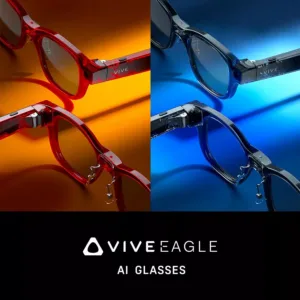
On April 21, 2026, HTC NIPPON held a product launch event for its new AI glasses, “VIVE Eagle.” At the event, they discussed predictions for the future of AI and their strong commitment to the Japanese market. This report covers the event, including the feel of the actual device and the Q&A session.

On April 21, 2026, a product launch event for HTC NIPPON’s new product, “VIVE Eagle,” was held in Tokyo. At the event, Huang Charles, HTC Senior Global President Vice, took the stage. In addition, Masada Yuya, HTC Manager, and Yamashita Kenji, Head of Sales & Marketing at HTC NIPPON, spoke about the product details.
“70% of questions asked to AI are unrelated to work,” says Charles Huang, discussing the ideal device for personal AI.

Charles Huang, who took the stage to kick off the presentation, spoke about the current state of AI use and the future device vision that his company envisions. Huang pointed out that “the industry is focused on productivity and efficiency, but the actual usage scenarios of people are much more personal.”
“According to 2025 data, of the more than 1.9 billion questions asked of AI, a staggering 73% were unrelated to work. People are using AI for therapy, companionship, organizing their lives, and discovering their purpose in life. The use of AI is fundamentally shifting towards something deeply personal.”
Huang argued that traditional smartphones, which are “devices that rely on thumb and screen operation,” have limitations in unlocking the true potential of this personal AI.
Unlike smartphones that are kept in your pocket, glasses are something people wear and carry with them every day. We are confident that AI glasses will become the new standard form factor for next-generation smart devices. We have designed a companion that empowers your life without infringing on your privacy.
Design and optical technology condensed into the frame, for all-day wear.

Next, the “VIVE Eagle” was introduced again. It’s a lightweight smart glasses weighing less than 49g, equipped with an AI assistant. It allows for voice commands to take photos and videos, play music, answer questions with the AI assistant, and perform real-time translation. The AI assistant supports OpenAI GPT and Google Gemini.
Masada Yuya described the “VIVE Eagle” not as a “gadget to show off technology,” but rather as “eyewear that blends seamlessly into everyday life.”
“The goal was to create glasses that could be worn comfortably from the moment you wake up until you go to sleep. To achieve this, we’ve made the frame itself incredibly lightweight at just 43g (the entire device weighs approximately 49g). We’ve aimed for a level of balance and fit on the ears that will satisfy even the most discerning eyewear enthusiasts.”
The smart glasses that were actually unveiled had a semi-transparent frame that allowed a glimpse of the intricate internal structure. The lenses were made by ZEISS, which boasts world-class optical technology, achieving a balance between visibility and safety.
Regarding the sound, they stated that “instead of blocking out the surroundings, we focused on an open-ear design that seamlessly blends real sounds with the AI’s voice.” As for the camera, they explained that “the camera, which can record the scenery as seen through your own eyes, was chosen to preserve the ‘atmosphere of the place’ that is lost the moment you point your smartphone at it.” Pointing a smartphone makes it obvious to the other person that you are taking a picture, which can create tension in the situation, but there is no such worry with smart glasses. It seems that the concept of being able to use it naturally in everyday life is also connected to these kinds of features.
Emphasis on privacy protection
However, the inclusion of camera functionality in smart glasses is currently a subject of much debate worldwide. While it would undoubtedly lower the barrier to surreptitious filming, the risk of AI using captured data without permission cannot be denied. Currently, because the devices are in their infancy, this hasn’t led to major problems, but privacy protection will remain a crucial issue.

The most passionate part of the presentation was the explanation regarding privacy considerations. In response to concerns about “surreptitious filming” associated with camera-equipped glasses, Masada presented a hardware-based solution.
“The LED light indicating that recording is in progress is linked to a sensor that prevents the camera from activating if it is physically blocked. Furthermore, the function immediately turns off if the glasses are removed. Technology can only truly integrate into society when it has the trust of those around it. We will not compromise on this rule.”
During the Q&A session, when asked “What happens if the LED is directly destroyed?”, the answer given was that it would similarly become impossible to take pictures.
Furthermore, the AI function “VIVE AI” has obtained “ISO27001” and “ISO27701” certifications (*), meaning that user data will not be sold or used for educational purposes. This is likely to be an important point not only for personal use but also when companies consider using smart glasses for business purposes.
* “ISO 27001” and “ISO 27701”: International standards for “information security” and “privacy protection.” They incorporate the concept of protecting individual rights, and the system that protects entrusted data from misuse and leakage is certified by a third-party organization.
KDDI and Paris Miki are collaborating on a domestic expansion. The product will be released on April 24th, starting at 82,000 yen.

Finally, Yamashita Kenji, Head of Sales & Marketing, and Kondo from partner company KDDI, announced the sales strategy for Japan.
“We don’t want new technologies to be just a passing fad. We want them to be useful in everyday life and easy to use. We want to spread them based on this foundation,” says Yamashita. As part of this strategy, they have teamed up with eyewear specialty store “Miki Paris” and telecommunications carrier “KDDI.” They plan to set up hands-on experience corners in approximately 70 au Style stores nationwide, creating an environment where people can actually try on the devices and confirm the convenience of AI.
The price is ¥82,500 (tax included) for the sunglass lenses and clear lenses, and ¥98,000 (tax included) for the photochromic lens model. It will be available in four colors: black, berry, coffee, and gray.
Reason for not including a display: We will consider including one depending on technological advancements.

The VIVE brand, which has previously focused on immersion in “virtual space” primarily through the sale of VR headsets and tracking devices, has deliberately chosen to “omit a display” for the VIVE Eagle. Towards the end of the interview, the question about the display came up during the Q&A session. When asked about the reason for not including a display, Mr. Huang replied as follows:
“The reason is very simple: we believe that language (voice) is the best interface with AI at this time. Adding a display would first increase the weight, and weight balance would become more difficult. There are also issues with power consumption and heat generation. Most importantly, we determined that current display technology is not sufficient for a good user experience. We want to consider it as the next step once the technology has advanced sufficiently.”
Currently, smart glasses come in a variety of types, from those that only provide audio to those that primarily display video, and even those that display only simple information in green text. While the VIVE Eagle focuses solely on audio for now, it doesn’t rule out the possibility of various variations appearing in the future. In that sense, we’re already curious to see what their next move will be.
Hands-on experience
After the press conference, I immediately tried out the actual device.

The top pair has a black frame and clear lenses, while the bottom pair has a coffee (brown) frame and sunglass lenses. At first glance, they look like ordinary black-rimmed glasses or sunglasses. Including the lenses and temples, they were about the same size as the “Rokid Smart AI Glasses.”
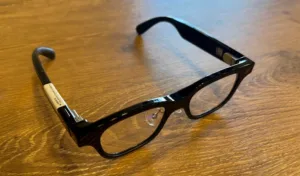
When I actually held the “VIVE Eagle” in my hands, I felt that it had a better balance of weight compared to the “Rokid Smart AI Glasses,” which have the same weight specifications. This is just my impression when comparing the two, but the “Rokid Smart AI Glasses” felt a bit wobbly when lifted, perhaps because the temples (arms) were slightly heavier than the lenses, whereas the “VIVE Eagle” felt lighter and easier to hold.
Next, regarding the functions, I tried out three: the camera (photography), transcription and summarization, and the speaker. (The AI assistant function was skipped due to time constraints.)

First, let’s look at the camera function. You can check the photos you’ve taken on the app. I tried taking a photo in the experience corner (right). Similar to the camera on the “Rokid Smart AI Glasses,” the vertical shooting range is wide, and I felt it would take some getting used to. Although this test unit did not support it, it is said that you can also take photos using voice commands.

The image on the right is the transcript after the recording, and the image on the left is a summary of the transcript created using AI. In addition to highlighting the key points, it also recognizes that there are two participants (the author and the person conducting the experience). It seems sufficient for use in meetings and similar settings.
Finally, regarding the speaker function. Although the venue was somewhat noisy, at around 50% volume, the sound was barely audible when facing the speaker, and could only be heard by putting your ear close to it.
The VIVE Eagle’s AI assistant function allows for hands-free operation via voice commands. While it supports basic operations such as taking photos and videos, what’s particularly noteworthy are the commands that utilize visual information.
For example, simply asking “What do you think of this place?” instantly reveals reviews of the store you’re currently viewing. This eliminates the need to take out your smartphone and search for the store name, making it extremely convenient for walking around town.
Furthermore, what I’m most looking forward to is the recording and memo function for VIVE AI. Simply by giving instructions such as “Record this address” or “Note down where I parked,” the AI will remember the information.
I, too, have often found myself too lazy to take out my smartphone and relied on my memory, only to end up wandering around a shopping mall looking for my car. I also frequently forget things like thinking “I’ll write it down later” when my hands are full. It seems that the VIVE Eagle could smartly prevent these kinds of minor everyday stresses.
Due to time constraints, I wasn’t able to try out the AI assistant features this time, but when I get my hands on one, I’d like to thoroughly test the accuracy and response speed of these commands. (Other voice commands can be found here.)
The smart glasses development race is heating up; who will take the lead?
While many competing smart glasses are appearing on the market, most devices currently offer limited opportunities for hands-on experience before purchase. In this context, the VIVE Eagle stands out because it has a larger number of stores offering demonstrations, purchases, and repair services compared to other smart glasses. The availability of stores where you can physically interact with the device before buying is a significant advantage. (Click here for stores offering demo experiences.)
Furthermore, the company’s focus on privacy protection, including consideration for cameras and ISO standards, is commendable. Its affordability and commitment to privacy protection may lead to it becoming a leader in the Japanese market.
With crowdfunding campaigns on Makuake exceeding 400 million yen for “Rokid Smart AI Glasses” and “Ray-Ban Meta” scheduled for release in Japan, we will continue to watch with interest to see what updates and differentiations “VIVE Eagle” will implement in the future.


This article is an English translation of an original Japanese article, translated by the Mogura VR editorial team.
Reference
Materials provided by the other party
Related Articles