
Many people would immediately think of Fuji Television’s spherical observation deck, “Hachitama,” when they hear “a building in Odaiba.” That silver sphere, reminiscent of a UFO from a classic science fiction movie, is now being transformed into a spaceport bound for Mars.
“THE SUNSET OF MARS,” which will be held from Saturday, April 25, 2026, is a next-generation VR attraction that will make “future travel to Mars” a reality by utilizing the latest XR technology.
What awaits participants is a futuristic Mars tour that begins with rocket takeoff, traverses the Martian landscape in a rover, and witnesses the Martian’s unique “blue sunset.” This article will show you what “Mars exploration” is like, which you can enjoy by actually walking around on your own two feet, rather than using a controller.
The journey begins with checking in on the 25th floor of “Hachitama”.

“THE SUNSET OF MARS” will be held at “Hachitama,” a spherical observation deck located on the 25th floor of Fuji Television in Odaiba. Following the directions, take the elevator from the rooftop garden on the 7th floor.
Upon entering the venue, first store your belongings in the lockers on the left side of the entrance. This attraction is a “free-roam” type, allowing you to walk around the VR space on your own, so try to wear as little clothing as possible.

Next, we headed to the check-in counter.
Here, you’ll use a tablet device to select your avatar, take a photo of your face, and set a passcode. The passcode is required to download the photos you take during the experience, so choose an easy-to-remember 8-digit number.
 (This was a video playing inside the venue, like an arrival/departure information board. After doing some research, it seems that THARSIS, ELYSIUM, and HELLAS are all names of plains or plateaus on Mars. There are also some names of asteroids that sound familiar.)
Experience a tour from Odaiba to Mars! Step into the world of ‘THE SUNSET OF MARS’!

After showing the admission ticket issued at the check-in counter to the staff, you will put on the VR goggles (PICO 4 Ultra Enterprise).
Incidentally, this attraction uses hand-tracking controls that don’t require a controller, making it intuitively enjoyable even for VR beginners. The design that allows for comfortable wear even while wearing glasses will also be a welcome feature for many users.
Apparently, this “trip to Mars” is a group tour. The four of us, including myself, all put on VR goggles at the same time and headed to a small room surrounded by partitions. At this point, we could still see the real world, but after listening to instructions on how to use the camera function, the door at the back of the room opened.
Now, let’s set off for Mars!
 (The small room you are first led into. Up to this point, the display shows the indoors of the real world, but beyond the opened door is clearly the outdoors. From here on, you will be walking entirely within the VR world.)


The city skyline of central Tokyo stretching out before us, and the vibrant colors of the setting sun illuminating them, are captivating, but our destination is “Mars.” Guided by the announcement, we walk towards the lift.
Standing in the designated spot and pressing the button in front of you causes the lift to rise, but it was surprisingly immersive and gave me quite a chill. That’s because this lift doesn’t have a safety railing. Being made to wait for a while in that state at a height that makes your legs tremble is indeed frightening. It’s no wonder that the warning included, “Caution for those with acrophobia.”
Once everyone in the group had completed the operation, the lift slid to the side and was retracted into the rocket. We then boarded the rocket, and what surprised me was that we were instructed to “sit” in the chairs in front of us.

As you can see, a 3DCG “chair” is displayed in front of me as I wear the VR goggles. When I cautiously reach out my hand… lo and behold, I can feel the hard sensation of an armrest.
Apparently, there were chairs prepared in the real world that we could sit on. The other participants in the group were all expressing their surprise, as they hadn’t expected there to be actual chairs.
Now, once everyone is seated, the launch sequence begins.


As the chair vibrates and grand music plays, the cityscape recedes further and further below. We pierce through the clouds, break through the stratosphere, and in an instant reach outer space.
While listening to the navigation AI’s explanation, the spacecraft arrived at Mars.
Next, we entered the landing sequence, and Mars, which had been visible in our field of vision, gradually drew closer. As the surface filled our entire field of vision, we entered the atmosphere. We were able to experience the entire process, from our prime seat, as the plane adjusted its trajectory towards the base built on the orange surface and landed on that land.


A seamless Mars journey, exploring on foot.

Upon arriving at the base, the Mars exploration officially begins. This trip will take you to several areas of Mars.
The sequence of events is as follows: first, you’ll look out over the orange surface from an observation point, then learn about Mars at Mars Base, the exploration base. And finally, you’ll have the experience of witnessing the “blue sunset” sinking into the Martian sky.
From here on, you’re free to move around, so you can quickly browse through the exhibits or take your time looking at any that catch your eye. However, once you move to the next area, you can’t go back to the previous one, so first, make sure to check out everything in the area you’re in.
 (A very Martian-like statue stands at the landing site. Approaching it reveals an explanatory text related to H.G. Wells’ *The War of the Worlds*. The vehicle visible in the background is the rover used for transport.)
 (Shot from atop a moving rover. While there wasn’t any shaking underfoot, it was surprisingly immersive, and the other participants in the group were all cheering.)
 (A viewpoint where the title logo appears. Don’t forget to take a commemorative photo in selfie mode!)
 (This is what it looks like when you take a selfie (※the face has been edited). It has a timer function, so you can even make a peace sign.)
 (A celestial model of Earth, Mars, and the Moon. Each celestial body has a different gravity setting; when you throw Earth, it falls as expected, but when you throw Mars or the Moon, they float slightly as they fly.)
 (Mars Base is an exhibition area that’s like a small museum, where you can learn the basics of Mars.)
 (Ice cut from the polar ice caps (north and south poles) of Mars. Visitors can experience breaking it with an ice pick. Approaching the plant in the back, you can read an explanation about food on Mars.)
 (I grabbed an ice pick and started to break the ice…)
 (Something’s come out! …That face looks incredibly familiar…)
The number of exhibits themselves is not particularly large. However, because you need to approach each one on foot and observe it up close, time flies by quickly if you take your time to engage with them. Many of the exhibits involve active physical actions such as “holding,” “touching,” and “breaking,” stimulating both intellectual curiosity and tactile pleasure.
Furthermore, and this is something I realized in retrospect, all of the experiences up to that point were structured as one large, seamless “trip to Mars.” There was absolutely no moment where the sense of immersion was broken or where I felt something was missing.

Given the setting of “future travel to Mars,” it wouldn’t be surprising to see sci-fi elements like super-fast transportation or warp drive systems, and these could easily be represented in VR. Yet, such elements were almost entirely absent from this attraction.
You board a rover that feels like an extension of modern vehicles, and even when getting in and out, there are no scene transitions using the “black-and-white” effect that is common in VR. Come to think of it, even the atmospheric re-entry scene was like that.
From putting on the VR headset and walking through the first door, to boarding the rocket, exploring the Martian landscape, and finally taking off the goggles, there should not have been a single “cut for dramatic effect.”


Having enjoyed a seamless Martian journey as a cohesive “experience,” the climax is nothing short of breathtaking. It’s the experience of witnessing the “blue sunset” sinking into the Martian sky from the window of a moving rover, which is also the title of this event.
I’ve deliberately chosen not to include any photos of the scene here. I urge you to visit the venue and experience the colors for yourself. It begins with a distant view of Earth’s “blue sky and red sunset” and ends with a view of Mars’ “red sky and blue sunset.” The beauty of the striking contrast was truly captivating, making it a highly satisfying attraction.
The physical action of “sitting” further enhances the immersion of free-roam VR.

The most distinctive feature of “THE SUNSET OF MARS” is its use of “Scape,” a proprietary XR platform developed by ABAL Inc., the company responsible for its production.
This technology expands a limited venue space into a vast VR environment 10 to 20 times larger. Furthermore, it enables large-scale operation, allowing up to 100 people to experience it simultaneously.
This uses the same system as the VR horror attraction “Senritsu Meikyu: Mei” that the company produced in 2025. That event attracted more than 20,000 people at Tokyo Tower and then went on a nationwide tour. It can currently be experienced for a limited time until June 14th at the 6th floor of DiverCity Tokyo Plaza in Odaiba.
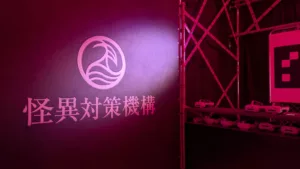
Although there are differences in setting and genre—”a trip to Mars” versus “investigating an abandoned hospital”—this latest installment, “THE SUNSET OF MARS,” shares many similarities with “The Horror Labyrinth: The Labyrinth of Terror” in terms of overall flow, system, and the quality of the experience.
The experience includes an avatar system using facial photos and a camera function that allows for selfies. During the experience, you can feel the presence of other participants, chat with friends, and walk around on your own two feet. After the experience, you can download the photos you took and enjoy sharing your memories on social media.
On the other hand, if I were to point out a difference from “The Horror Labyrinth: The Labyrinth of Doom,” I would say that the comfort level of the VR experience as “dozens of people walking around in a limited space simultaneously” seemed to have improved.
 (In “The Terrifying Labyrinth: The Labyrinth,” other participants are displayed as black silhouettes. A circular glowing ring is also displayed at their feet, but it is somewhat difficult to see in the dimly lit abandoned hospital.)
This is because, in “The Horror Labyrinth: The Labyrinth,” where other participants are displayed as black silhouettes, there were several instances where players bumped into people around them (*). Even a single contact can naturally trigger an awareness of “I need to be careful not to bump into anyone,” potentially diminishing the sense of immersion.
In this respect, it was easy to see the other participants this time, and there were no instances where their positions appeared significantly different. Rather, there was a sense of realism that made it feel like we were on a large-scale sightseeing tour of Mars, and I felt that I was naturally immersed in the Martian landscape before my eyes and the experience there.
(However, in the case of “The Terrifying Labyrinth: The Labyrinth,” there are genre-specific considerations, such as the fact that “increasing the visibility of other participants might diminish the sense of horror,” so finding the right balance seems difficult.)
 (In “THE SUNSET OF MARS,” members of the same group are displayed as avatars with their faces shown in the right and center photos, while other participants are displayed as light blue, semi-transparent figures as shown in the left photo.)
In terms of “immersion,” it’s worth noting that elements that directly appeal to the five senses were included early on. That’s the experience of “sitting in the seat of a rocket.”
This is a slight spoiler, but in “The Horror Labyrinth: The Labyrinth of Terror,” there’s a scene near the end where you’re instructed to “sit in a chair.” When you reach out to the chair, which is only 3DCG and visible through the VR headset, you can actually feel the chair’s texture and sit down.
I remember being deeply moved by that first experience at the time, but also genuinely terrified by what happened next. In “The Sunset of Mars,” the symbolic experience of “sitting” appears so early that I was taken aback, thinking, “This early in the game?!”

Moreover, this time it came with vibrations and a roaring sound. It wasn’t just a matter of “touching and sitting,” but rather “touching, sitting, and being shaken violently,” which literally shook my whole body, and I was thoroughly impressed. In that sense, I have to say that this structure of “having an experience involving physical movement at the beginning of the attraction” was extremely effective.
By making participants physically experience the sensation of “there being a chair to sit in, just like in reality,” rather than simply “seeing 3DCG through a VR headset (which doesn’t actually exist),” the level of immersion in the VR space is dramatically increased. In fact, one participant in the same group as me almost leaned on the handrail of the rover used for transportation and stumbled slightly.

There are many VR contents set in space and on planets that exist in reality but are difficult for humans to visit, and you can experience them at home if you have VR equipment. I myself often play in space-themed worlds in VRChat, but the experience with “THE SUNSET OF MARS” was something I could never experience at home.
This is a dream experience that humanity has yet to achieve: walking on Mars with your own two feet. It goes without saying that this cutting-edge free-walking VR experience is well worth seeing, and it’s an event recommended for a wide range of people, from couples to families. Above all, it’s an experience that we especially want people who simply “love space!” to try.
How about Mars, with its stunning blue sunsets, as a destination for your Golden Week getaway?
“THE SUNSET OF MARS” Event Overview
| Event period | April 25, 2026 (Sat) – June 28, 2026 (Sun)
*The following dates are for Saturday, Sunday, and public holiday business hours. |
| Business Hours | Weekdays 11:00 AM – 7:00 PM / Weekends and Holidays 10:00 AM – 7:00 PM (Last appointment 6:30 PM) |
| Venue | Fuji Television’s spherical observation deck “Hachitama” (2-4-8 Daiba, Minato-ku, Tokyo, Fuji Television Building, 25th floor) |
| Rates (weekdays) | Adults: 3,700 yen / Children under 18: 2,300 yen (tax included) |
| Rates (weekends and holidays) | Adults: 4,200 yen / Children under 18: 2,800 yen (tax included) |
| Purchase tickets | https://thesunsetofmars.abal.jp/release
*The following dates are for Saturday, Sunday, and public holiday tickets. *Advance tickets are time-specific. *While you can purchase tickets at the venue on the day of the event, depending on the sales of advance tickets, you may have to wait to enter or may not be able to purchase tickets. We strongly recommend purchasing tickets in advance. |
| Supported Languages | Japanese/English |
| Age and height restrictions | Children under 7 years old and under 110cm tall are not permitted to participate. Children under 12 years old require parental consent. |
| Duration | About 30 minutes |
| Organizer | THE SUNSET OF MARS Production Committee |
© THE SUNSET OF MARS Production Committee