
MoguraVR, a media outlet specializing in XR, metaverse, and VTubers, broadcasts its weekly podcast, “Mogu Radio.” Based on the concept of “digging into the forefront of the tech content industry,” Sunkubo (Editor-in-Chief of MoguraVR) and Yuriika (Deputy Editor-in-Chief of MoguraVR) discuss noteworthy topics in the industry.
This time, we’ll discuss the new device “Project Swan” and its new OS “PICO OS 6” announced by Chinese VR headset manufacturer Pico. Aimed at spatial computing, this device features a high-resolution microOLED display and a proprietary chip called “Pico Silicon,” with specifications that seem to be aimed at the Vision Pro. As the premium market in the VR headset market moves again, how will the market change in 2026-2027? We’ll analyze this, incorporating a report from GDC.
(※This article is a summary and edited version of a conversation from the podcast “Mogu Radio”)
https://www.youtube.com/watch?v=0Px9_VwLujk
A report from Sunkubo, who is at GDC.
Yuriika: This time it’s a remote recording, but where are you located?
Sunkubo: I’m currently in San Francisco, USA. I’m here for the Game Developers Conference (GDC), which is held annually in the United States.

Yuriika: It’s one of the world’s largest game developer conferences, right?
Sunkubo: That’s right. However, the scale has shrunk considerably in recent years. The number of sessions and the size of the exhibitions have been decreasing year by year, and I think those who have been following it for a long time will feel the change the most. That being said, there were hundreds of sessions, and I also conducted individual interviews, so there was plenty to take away from it.
Pico suddenly announces “new headset”
Yuriika: Amidst all that, some interesting information has emerged regarding GDC, hasn’t it? It’s about Pico’s new developments.
Sunkubo: It was announced right at the beginning of March. They announced that “the details will be discussed at the GDC presentation.” There, as a major announcement, a new VR headset and a new OS were revealed. The new headset is described as a “headset for spatial computing,” and its codename is “Project Swan.”
Yuriika: What’s the status of the new OS?
Sunkubo: The OS has been upgraded to “PICO OS 6”.
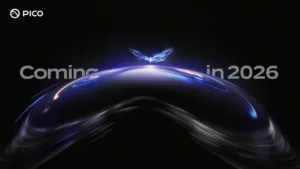
Yuriika: This year there was a lot of talk about smart glasses, but headsets had calmed down since the Galaxy XR was released last November. There was also talk that Meta wouldn’t be releasing any headsets this year, so I was wondering what would happen, and then Pico suddenly came along.
Sunkubo: That’s right. It looks like they’re challenging Meta, saying, “If you won’t release it, we’ll release it.”
What kind of manufacturer is Pico?
Yuriika: Could you tell me more about Pico?
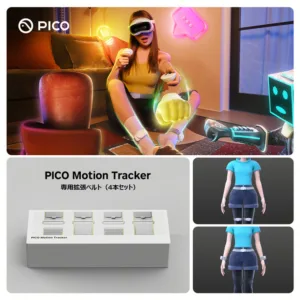
Sunkubo: Pico is a Chinese VR headset manufacturer that has been making standalone headsets (which operate independently without a PC) since around 2016. After the “Pico Neo” series, they recently released the “Pico 4 Ultra.” In terms of performance, it’s on the same level as the Meta Quest 3 and 3S, and they have also developed their own optional accessories such as motion trackers that detect full-body movements. In 2021, it was acquired by ByteDance, the company that operates TikTok, and is now a brand under the ByteDance umbrella.

Yuriika: It’s a situation where social media platforms like TikTok’s ByteDance and Facebook’s Meta are fiercely competing with each other. However, while Pico is linked to TikTok, it’s on a small scale. I get the impression that the collaboration isn’t very strong.
Sunkubo: It’s completely different compared to Meta, which has firmly linked VR and social media. In the market, Meta is leading the VR headset market, and to be honest, Pico is in second place.
Let’s summarize the content of the Project Swan presentation.
Yuriika: Now, let’s take a look at the content of Project Swan’s presentation.
Sunkubo: First of all, the phrase “headset for spatial computing” was striking. The term “spatial computing” is a term that only Apple Vision Pro has used until now.
Yuriika: That’s right. It already has that Vision Pro feel to it.
 (Pico 4 Ultra | Image courtesy of Pico Interactive)
Sunkubo: Regarding the hardware, the developers only gave a brief explanation, but first, the display will achieve a resolution of over 40 PPD. PPD stands for pixels per degree, and it is an indicator of pixel density. Apple Vision Pro is said to have about 35 PPD, so this is a higher number. The display type is microOLED, and it uses a high resolution and good color reproduction rather than a price-conscious LCD. In addition, by combining “microlens array technology” and “brightness correction,” the image will be even more beautiful.
Yuriika: In terms of appearance, the front part, which uses glass, seems to be inspired by the Vision Pro, doesn’t it?
Sunkubo: That’s right. It has a texture similar to the parts of the Vision Pro that used glass, and it has a premium feel, but I’m curious to see how they’ve designed it considering the weight issues that were pointed out with the Vision Pro. As for the chip, it consists of two chips: the flagship SoC (the main chip that powers smartphones and headsets) and Pico’s own “Pico Silicon.” Pico also emphasized the term “Pico Silicon” in their presentation at GDC.
Yuriika: That name is reminiscent of “Apple Silicon,” which Apple uses in its Macs.
Sunkubo: That’s right, and the two-chip configuration is the same as Vision Pro. Vision Pro combines a chip for video processing with a dedicated chip “R1” that processes sensor and camera information. Pico’s Project Swan has a similar structure. They say that this makes processing more efficient and reduces latency (delay) to 12 milliseconds.
New OS “PICO OS 6” and spatial computing capabilities
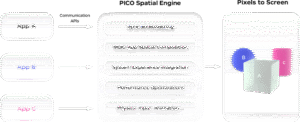
Sunkubo: Next, looking at the OS side, this time it is equipped with a feature called “PICO Spatial Engine”. This is a mechanism that handles rendering (the process of generating images) on the OS side, so that 3D content and windows such as apps can be run in an integrated manner at the OS level. The test video showed how to open a schedule book while displaying a game, and how to play another game while watching a video.


Yuriika: We called it “spatial multitasking.” It’s like a PC desktop has been transformed into a 3D environment, and it’s a usage similar to Vision Pro.
Sunkubo: With previous Pico devices, it wasn’t possible to use multiple windows side-by-side. To realize spatial computing, the quality of “video passthrough (passthrough AR),” which displays the real world through the headset’s camera, is also important. For example, you need an experience where you open a window in front of your desk, get up to get coffee, and come back, and the window remains fixed in the same position. This requires the ability to display the real world in high quality without delay. PICO OS 6 will incorporate all of these functions together.
Yuriika: Another thing I found interesting was the UI language called “Cloud Crystal.” Apparently, the font weight changes in real time according to the ambient light, and the UI design makes virtual elements blend naturally into reality. I felt that this concept is similar to the “Liquid Design” adopted by Apple’s iOS.
Sunkubo: That’s right. Furthermore, it also supports “multimodal interaction,” which combines multiple control methods such as voice, eye tracking, and hand tracking. Compared to the previous Pico 4 Ultra, which was positioned as a VR game console that relied on controller operation, this is quite a change in direction.
Yuriika: The official statement says that VR games will continue to be playable, but it seems like the trend of new apps coming out in the future will change.
Sunkubo: Yes. The overall picture of the device is still unknown, and we don’t know the shape of the battery either. Vision Pro had a wired external battery, but it’s still unknown what form Project Swan will take. As for content, they are currently calling on developers to support the OpenXR common standard, Unreal Engine, and the ability to run regular 2D apps, so it seems like they are aiming to raise the flag and then have the content come together.
Two lineages of the VR headset market
Yuriika: First of all, how is Project Swan positioned within the context of the VR industry?
Sunkubo: To understand this, we need to look back at the evolution of the VR headset market. In fact, there are two lineages of VR headsets: the “premium line” and the “casual line.” First, when the market started in 2016, it was the premium line. At that time, all headsets such as PSVR and HTC Vive required a wired connection to a gaming PC, meaning you needed to buy a PC costing over 300,000 yen in addition to a headset costing over 100,000 yen. The concept was highly immersive VR games for core gamers.
Yuriika: Just experiencing VR was an incredibly high hurdle, wasn’t it?
Sunkubo: Next, around 2018-2019, the Meta Quest (then called Oculus), which could operate independently without a PC, appeared for $399, marking the beginning of the era of all-in-one VR. In 2020-2021, the Quest 2 was released in Japan for around 20,000-40,000 yen and became a huge hit, especially in the US. As a result, the main user base shifted from adults to teenagers. It was around this time that ‘Tag Gorilla’ appeared and became explosively popular among young people in North America as a free, fast-paced game. VRChat also saw an increase in users via Quest, and it was during this period that social VR among young people began to spread. This is how the “casual approach” became the mainstream of the market.
Yuriika: And the premium line once again gained attention in 2024 with the release of Apple Vision Pro.
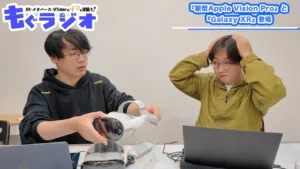
Sunkubo: That’s right. It plays a certain role as a premium device, such as for watching videos on a large screen or as an extended display when used in conjunction with a Mac. It can be said to exist as a solid segment within the casual market.
Project Swan is clearly a premium product, in contrast to the Pico 4 Ultra, which was aimed at a casual market. Meta is also developing a next-generation device called Phoenix, targeting 2027, and it’s not called “Quest 4,” meaning it’s seen as a different product from the casual market. Phoenix is rumored to be an ultra-compact and lightweight headset with a wired connection to a computing pack, which overlaps in direction with Project Swan.
Will the next group to arrive be the “mainstream adult audience”?
Sunkubo: At GDC, Pruett Chris, who has been with Meta since the Oculus days, gave a presentation called “State of VR.” Regarding the future of the VR market, he mentioned the “mainstream adult demographic” as the next user group to emerge.


Yuriika: I remember seeing an illustration of an exhausted-looking old man sitting in your presentation materials (laughs).
Sunkubo: That’s right. Specifically, it was described as a group of men between 35 and 45 years old who are married, have children, and have a certain level of income. One of the characteristics of this group that was mentioned was that they don’t do intense physical activity in VR. Rather than games that involve physical activity like Beat Saber or Gorilla Tag, they would mainly be watching videos on a large screen. Like movies and sports. In America, where TVs are tending to get bigger while remaining 4K, they said there is a demand for a single-person device that doesn’t require watching with family. As for games, they are not ultra-hardcore, but rather a mid-core group that plays puzzle games and turn-based RPGs at a moderate pace, and they tend to actively buy paid titles.
Yuriika: That’s easy to understand.
Sunkubo: The data showed that more than half of Quest 3 users use hand tracking every day. This means that controller-free operation is becoming the norm. This perfectly aligns with the direction of hand tracking that Project Swan is emphasizing.
Will 2026-2027 be the year of the premium route?
Yuriika: It looks like we’ll be seeing a lot of premium headsets coming out between 2026 and 2027.
Sunkubo: That’s right. But to be honest, it’s unknown how far that market will expand. The Apple Vision Pro doesn’t seem to be a huge hit, and the Galaxy XR seems to be struggling. Whether we’ll see an explosive increase in a completely new user base like when the Quest 2 and Gorilla Tag came out remains to be seen.
Yuriika: If the price range is around 200,000 to 300,000 yen in Japanese currency, some people might consider it as an alternative to high-end projectors or home theater equipment. However, many people in their 30s to 40s don’t have that much disposable income, and in Japan, the weak yen would make it even more expensive.
Sunkubo: Gaming PCs are also getting more expensive, and the rising cost of semiconductors and memory may be influencing product prices. With a succession of premium devices coming out, I think VR hardware will become more exciting. However, the moment the price is announced, many people will think, “This isn’t for me.” I don’t think Project Swan will come out at around 100,000 yen, the same price as the Pico 4 Ultra.
Yuriika: It would be interesting to clarify and explain to our readers the distinction between casual and premium products. The experience differs depending on the device, and reviews, including the differences between wired and wireless connections, will be important.
Sunkubo: That’s right. I think there are many things that can only be confirmed by actually touching and experiencing them. Project Swan is scheduled to be released sometime in 2026, so I hope to continue providing information.