
On Friday, July 24, 2026, a new attraction, “NARUTO Music Dancer,” will open at Tokyo Joypolis, an indoor amusement park in Odaiba, Tokyo.
This attraction is a music and dance game that combines the world of the globally popular anime “NARUTO” with Sony’s unique markerless motion capture technology. Its greatest feature is that players can enjoy the game by moving their bodies freely, without wearing any devices or controllers.
The unusual combination of “NARUTO x Dance Game” is certainly intriguing, but what’s also interesting is how Sony’s cutting-edge technology is being utilized. In this article, we’ll provide an overview of this new attraction and a report on the press preview held prior to its opening.
Get into full-body action to the tune of “Bluebird”! Move your body along with Naruto and Sasuke!

“NARUTO Music Dancer,” a new permanent attraction at Joypolis, is a music dance game that can be played by up to 5 people (minimum 1 person).
The gameplay is simple. Players move their bodies in time with the music, following the poses displayed on the screen, and aim for a high score together. The song used is “Blue Bird” by Ikimonogakari, which is popular both domestically and internationally as the theme song for the anime “NARUTO Shippuden”.


There are a total of six designated poses.
Many of the actions are familiar to Naruto fans, such as “Shadow Clone Jutsu,” “Ninja Run,” and “Chakra,” but some have specific hand positions and other details. Try to memorize them while you’re waiting in line for the attraction.
The attraction features two play areas, where players will take on missions alongside either Naruto or Sasuke. While the main storyline is the same, there is one significant difference depending on which character accompanies you.

That’s my special move.
In the climax of the dance game, you’ll perform the “Rasengan” in Naruto’s route and the “Chidori” in Sasuke’s route, together with the respective characters.
As I will go into more detail in the experience report below, you need to move your body a lot to build up your chakra before unleashing a special move, and there are flashy effects that play in real time when you activate it, so it was quite impressive and exhilarating.

Please note that for an additional fee (*), you can download gameplay videos and photos after the experience to take home the data. This video does not include the “Bluebird” sound source, but it is acceptable to post it on social media using music libraries officially provided by video apps, etc.
(*The price of the play data is 2,000 yen for videos, 1,500 yen for photos, and 3,000 yen for a set purchase.)
Could it be…it’s surprisingly hard!? A fun 5-minute game experience where we danced with all our might.

The expected experience time for this attraction is approximately 5 minutes.
While many arcade music games allow you to play two or three songs per session, this game only includes “Bluebird,” resulting in a considerably shorter playtime.
However, my actual experience was that 5 minutes was just the right amount of time, and I was very satisfied. This is because it involved more exercise than I expected, and I was slightly out of breath by the time I left the play area.


Enter the play area empty-handed, and once all players are positioned at their designated spots on the screen, the game begins. After a story segment featuring Naruto (or Sasuke) speaking, the tutorial will begin shortly.
The actual performance doesn’t start immediately; there’s a practice time beforehand, so don’t worry if you haven’t memorized all the poses while you’re waiting in line. Check the pose icons that scroll across the top right of the screen and move your body in time with them.
 (The pose for the “Summoning Jutsu”)
 (The “ninja run” pose)
 (Shuriken pose)
When I heard “strike a pose” before playing, I thought it would just be a slight change in posture. However, once the game started, I realized how naive that understanding was.
The “chakra” pose is essentially a “wide squat,” and while you might think the “shuriken” pose is just about throwing, there’s also an instruction to “stand on one leg.” Needless to say, the “ninja run,” which involves leaning slightly forward, raising both hands behind you, and marching in place, involves a lot of physical exertion.

Furthermore, the element of “judgment (*)” as a rhythm game is added to it.
During practice, all I had to do was follow the instructions on the screen, but in the actual performance, I naturally had to change poses in time with the music.
I managed to keep up at the beginning, but as the lesson progressed, the instructions to change poses in short intervals became continuous, and my body movements naturally became larger and faster.
(*The ratings appear to be on a four-point scale, from top to bottom: “MARVELOUS,” “GREAT,” “NICE,” and “BAD.” Higher ratings earn more points, so accuracy in timing is also required to aim for a high score.)


And the ultimate highlight is the finishing move that concludes the song.
If the accompanying character is Naruto, he will knead his chakra by “holding his right hand down and kneading with his left hand” and then unleash a “Rasengan”.

At first glance, the movements may seem simple, but the left hand in particular rotates the entire arm in a large circle, resulting in a considerable amount of exercise. The photo above shows a demonstration, and it was observed that the faster a player’s hand movements were while cultivating chakra, the larger and more spectacular the on-screen effects became.
And one more thing.
When your companion is Sasuke, his special move is “Chidori,” and naturally, the method of cultivating chakra is different from Naruto’s “Rasengan.” When using a special move in Sasuke’s route, the following instructions will be given:

Yes, I’ll run.
The “ninja run” pose is also a running motion, and just as the power of the “Rasengan” increases the faster the hand movements, the more chakra can be generated with the “Chidori” technique the faster the movements are.
In other words, it means you’ll be doing a high-speed sprint in place.
I played the Sasuke route, and by the time I got there, I was completely engrossed in the game, so I put all my energy into moving my legs to perform this special move. As a result, despite the short playtime of about 5 minutes, I was so exhausted after playing that I was slightly out of breath.
In other words, it was a game experience that, despite being short, provided such a high level of immersion and satisfaction that you completely lost yourself in it. Since there’s no need for tedious preparation or calibration before playing, I’m sure it will become a popular attraction with a high turnover rate.
Simultaneous tracking of up to 10 people is also possible! Features Sony’s proprietary markerless motion capture technology.
What surprised me most when I actually experienced the attraction was the high accuracy of the motion capture.
Conventional motion capture and immersive VR attractions require players to wear optical markers or trackers on their bodies or hold special controllers. However, with “NARUTO Music Dancer,” players can enter the play area and start playing immediately in their everyday clothes without wearing any devices.
Furthermore, I felt that it not only determined “what pose was being made” in real time, but also judged “whether the timing was correct” with extremely high accuracy.
When I realized, “Oh, that was a little too late!”, I was strictly judged as “BAD,” but when I felt like I had nailed it, I was given a clear “MARVELOUS” or “GREAT” rating. It’s designed to provide not only the exhilarating feeling of moving your body, but also the satisfying feeling and enjoyment of a rhythm game.
This completely markerless and highly accurate tracking is achieved through the collaboration of eight cameras positioned in the booth and Sony’s proprietary advanced AI analysis algorithm.


Eight cameras capture the players’ movements from multiple angles, and AI extracts and measures the bone (skeletal) data of all participants in real time. By instantly calculating the positional relationships and combinations of joints, the system accurately recognizes “what pose the player is currently in,” and immediately feeds this information back into on-screen effects, judgment processing, and even the compositing of life-size images onto the screen.
Another noteworthy feature is its ability to prevent tracking errors caused by overlapping characters, even in environments where up to five players are moving around in the same space, and to continuously track each individual’s skeleton in real time.
With five people moving and overlapping, you’d expect some degree of positional inaccuracy, but I never felt like the tracking was lost during the experience. The placement and timing of the on-screen effects also felt natural and unnatural.
What’s even more surprising is that while the attraction has a maximum capacity of 5 players, it’s technically capable of tracking 10 or more players simultaneously. Yoshida Yusuke, Manager General of the Section Platform, Planning Business Department, Marketing Sony, who was in charge of the attraction, explained that “it’s a highly flexible system that can adapt to spaces of various sizes.”
Beyond its introduction to amusement facilities like this one, there are high expectations for its wide-ranging applications in the future.
LBE business with a view to global expansion

Marketing Sony Inc. was responsible for the planning, development, and overall design of “NARUTO Music Dancer.” Professional dancer TAICHI participated as dance supervisor, and Amano Kiyoyuki, an XR creator at Inc Kayac., was in charge of creative direction and content planning and development.
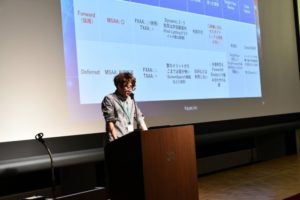
 (Naito Tomohiro, Head of Development Business Center, Marketing Sony Inc.)
At the press conference held that day, Naito Tomohiro, head of Marketing Sony’s Development Business Center, took the stage. He spoke about the company’s strategy for its Location-Entertainment Based (LBE) business, which it positions as one of its focus areas, under the banner of “creating new experiential value through the fusion of real and digital.”
Furthermore, it was revealed that the project originated from an inquiry about Sony’s creation technology from CA Sega Joypolis Co., Ltd., and Sony expressed a strong desire for global expansion, stating, “We are positively discussing business expansion both domestically and internationally in the future.”
 (Hara Takeshi, Executive Senior President Vice, CA Joypolis Sega Co., Ltd.)
Next, Hara Takeshi, Executive Senior President Vice of CA Joypolis Sega, took the stage and spoke about his expectations for the attraction from the perspective of facility management.
Mr. Hara mentioned that the period of approximately one year starting in July 2026 will be Joypolis’s 30th anniversary year, and commented with delight, “I am pleased that we can announce ‘NARUTO Music Dancer’ as one of the main attractions in this momentous year, together with Sony.”
In addition, they emphasized that by combining the globally renowned IP “NARUTO” with Sony’s cutting-edge technology and using “music and dance” as a theme to transcend language barriers, “the content will be enjoyable not only for people in Japan but also for inbound tourists from overseas.”

Located in Joypolis, a popular destination for international tourists, “NARUTO Music Dancer” is a collaboration between the globally popular IP “NARUTO” and Sony’s cutting-edge technology.
This spot is sure to attract the attention of overseas fans, but despite being a game that utilizes cutting-edge technology, its accessibility—the fact that you can “just drop by and enjoy it quickly without any special preparation”—is also a major appeal of this attraction.
This cutting-edge attraction allows you to jump in hands-free, without wearing any devices. When you visit Joypolis, why not experience this next-generation AI-powered tracking technology with your whole body?
“NARUTO Music Dancer” Overview
- Opening date: Friday, July 24, 2026
- Installation location: Tokyo Joypolis 1st Floor
- Experience time: Approximately 5 minutes
- Number of players: 1-5 (maximum 5 players per Naruto/Sasuke route)
- Play fee: 1,000 yen per person (※Various passports accepted)