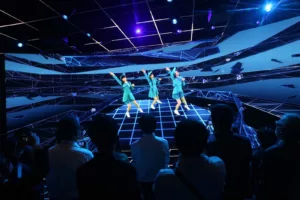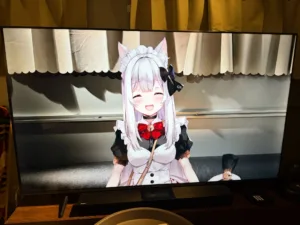
NTT Corporation and NTT DOCOMO, INC. announced the results of their field test of NTT East’s next-generation optical communication technology, “APN for IOWN.” They explained that they were able to connect a studio and a remote location in real time for a fan meeting with a VTuber, achieving a high-quality and low-cost event. Furthermore, they announced that they had successfully implemented self-haptics, allowing participants to high-five the VTuber with both hands.

This time, we will introduce the information that was revealed at the online press conference.
We achieved a high-quality VR fan meeting using “APN for IOWN” and reduced operating costs by approximately 20%.
The “APN (All-Photonics Network)” in “APN for IOWN” is a new technology that enables high-capacity data transmission with low latency and low power consumption by dedicating optical wavelengths to all sections of the communication network. Because it allows for more efficient communication than conventional WAN services, it is expected to be used in technologies such as real-time transmission of video from concerts and events.
“IOWN” refers to a concept for a next-generation information and communication infrastructure designed to address the challenge of ever-increasing and enormous power consumption. In other words, “APN for IOWN” can be described as a sustainable next-generation communication network.
This time, NTT and NTT Docomo conducted a demonstration experiment using “APN for IOWN” at a special event of “ConnectVFes” (to be held on March 15, 2026), a fan-participation live event where multiple VTubers appear and interact with the audience.

For this event, NTT Docomo’s XR studio (Odaiba, Minato-ku, Tokyo) and a separate experimental venue (Musashino City, Tokyo) were connected using “APN for IOWN.” This enabled a high-quality, highly immersive VR fan meeting and real-time call-and-response with fans.

Traditional VTuber live performances involve recording and filming using motion capture in a studio, generating XR content, and then distributing it to various streaming platforms and venues.

However, for in-person events, it was necessary to set up a temporary studio within the live venue to transmit video and audio over short distances without delay, which resulted in significant costs for moving equipment and staff. On the other hand, internet streaming makes it difficult to provide high-quality video and natural conversation, and pre-recorded content lacks a sense of presence, sometimes failing to generate sufficient excitement.

In this demonstration experiment, an interface conversion device equipped with HDMI signal conversion technology was used to connect the studio equipment and the venue equipment, demonstrating that it is possible to transmit video and audio to remote locations without degradation of video and audio quality or delay fluctuations caused by communication. It was revealed that operating costs were reduced by approximately 20% compared to on-site events where a temporary studio was set up within the live venue.
Participants were able to high-five VTubers using their own hands.
Furthermore, a key aspect of this demonstration experiment is the realization of high-fives between fans and VTubers in a virtual space, achieved through “self-haptics” (tactile technology using one’s own body).

Normally, it’s not possible to physically interact with characters in a virtual space. However, NTT stated that by combining their self-haptic VR tactile communication technology with commercially available VR headsets, participants were able to experience the sensation of high-fiving a VTuber in the VR space.

Specifically, participants first put on a VR headset, and virtual characters and fan avatars are displayed in the VR space. As they converse in the VR space, the left hand of the fan’s avatar is gradually drawn outwards, and the left hand of the virtual character synchronizes with the left hand of the fan. When the fan places both hands together in the real world, they get the feeling that they have high-fived the virtual character in the VR space.

According to the explanation, by using a visual effect that shifts the drawing position from its real-world position, users can experience a visual illusion and realistic tactile sensation, creating the feeling that they are physically high-fiving a virtual character, even though they are actually touching it with their own hand.

The results of a survey conducted among the 39 participants in this VR fan meeting experiment showed that they gave high marks for items such as “the feeling of high-fiving” and “a sense of unity with the virtual character.” In addition, all participants responded that they were “somewhat satisfied” or better with the fan meeting experience, and all indicated that they “would like to participate again.”
NTT and NTT Docomo announced that they aim to create new entertainment services by utilizing the latest technologies, including “APN for IOWN,” to provide services that allow VTubers and fans to interact in real time. They also stated that they will expand their business by collaborating not only with the NTT Group but also with partner companies and studios and venues both domestically and internationally.
“APN for IOWN” has already received high praise, having been adopted at the NTT Pavilion at “Osaka-Kansai Expo 2025” and “SHINAGAWA TECH SHOWCASE 2026,” among others. Combined with this new self-haptics technology, it is expected to evolve fan meetings between VTubers and their fans into even more precise and engaging experiences.
This article is an English translation of an original Japanese article, translated by the Mogura VR editorial team.