MoguraVR, a media outlet specializing in XR, metaverse, and VTubers, broadcasts its weekly podcast, “Mogu Radio.” Based on the concept of “digging into the forefront of the tech content industry,” Sunkubo (Editor-in-Chief of MoguraVR) and Yuriika (Deputy Editor-in-Chief of MoguraVR) discuss noteworthy topics in the industry.
The main topic we’ll be covering today is the series of new AR glasses announcements made at AWE USA 2026, one of the largest conferences in the XR industry. Snap announced its production version of AR glasses, “Spectacles,” while XREAL announced “XREAL Aura,” a device developed in collaboration with Google and Qualcomm. From hardware and chipsets to integration with AI, we’ll explore from the scene how smart glasses are approaching practical application.
(※This article is a summary and edited version of a conversation from the podcast “Mogu Radio”)
We’re bringing you this report from the World Cup venue! This is our first recording in two months.
Yuriika: The theme for episode 205 is “Snap and XREAL announce AR glasses, attracting attention! AWE USA 2026 on-site report.”
Sunkubo: I’m in America right now, so it’s been a really long time since I’ve recorded something like this.
Yuriika: It’s been about two months already.
Sunkubo: Today, I’ll be talking about AWE, one of the largest XR industry conferences held annually in the United States. It’s held in Long Beach, California, an area near Los Angeles. It coincides with the FIFA World Cup currently being held in North and Central America, so the area outside the hotel is bustling with people wearing Mexican uniforms. In fact, the Mexico vs. South Korea match is taking place, and the sounds of cheering and car horns can be heard constantly.

Yuriika: A completely different drama is unfolding (laughs).
Sunkubo: I can hear the sound of police cars, which is a little scary. It’s an unexpected coincidence that we’re both on the same plane to AWE.
What is AWE, and what does this year’s theme, “I, Spatial,” mean?
Sunkubo: I’ll share some photos on my screen. This is Inver Oli, the founder, giving a keynote speech at AWE. The skull-like object next to him is the Award Auggie trophy, which is presented annually at AWE. It’s a long-running event that’s been around since AR first gained popularity, and this award is held every year.
Yuriika: It has a striking appearance.
Sunkubo: This year’s theme is “I, Spatial.” This is a play on words from Isaac Asimov’s science fiction novel “I, Robot.” Physical AI (AI used for controlling robots, etc.) is currently gaining popularity, and behind it is a technology called the world model, which allows AI to perceive three-dimensional space. While the world model is often discussed in the context of robots, it can also be applied to AR if used as VPS (location data). That’s why this concept conveys the message that we are not robotic beings, but rather on the side of Spatial Computing, which is more human-centered.

Yuriika: That’s a pretty unique concept.
Sunkubo: AWE boasts of being the world’s largest XR industry conference, and I think that’s actually true. Every year, thousands of attendees, hundreds of exhibitors, hundreds of lectures, and hundreds of speakers gather from all over the world. Many large corporations also participate. I’ve been attending since before the pandemic, and it was initially held in Santa Clara, but moved to Long Beach as it expanded in scale. This will be my fifth or sixth time attending.
The exhibition floor space has been reduced in size, and here’s why
Yuriika: What was the atmosphere like at the venue this year?
Sunkubo: The lectures were as usual, but the most striking difference was the exhibition floor. There was a lot of empty space. With around 250 companies exhibiting, it felt less like a significant decrease and more like the venue was too big and they were underutilizing it. XREAL and Meta, who had large exhibits last year, didn’t even have a booth this year; Meta only made an announcement. XREAL was also limited to exhibiting in a small, private booth within the venue. The aisles also felt much wider than last year.

Yuriika: Why did that happen?
Sunkubo: I think a major factor is that the situation surrounding the industry is changing. In particular, the presence of AI. Talent and interest are flowing into the AI field, and I think there are inevitably fewer companies continuing in the XR field or entering it for the first time. Also, Apple has never exhibited at AWE, and there are years when Google doesn’t exhibit either. Just because it’s an industry event doesn’t mean all companies will gather. I think each company is choosing the way of involvement that suits them best. To give an extreme example, the number of vendors providing industry-specific B2B XR solutions has decreased considerably. Their purpose for exhibiting at trade shows is business matching, so I think people are flocking to specialized trade shows rather than cross-industry events like AWE. In fact, a separate trade show combining XR with various industries is now being held in Chicago around the fall. More and more companies are laying off employees, and I think it’s true that the industry as a whole is experiencing a bit of a plateau. On the other hand, there were a lot of smart glasses-related hardware exhibitors.
Snap announces “Specs”
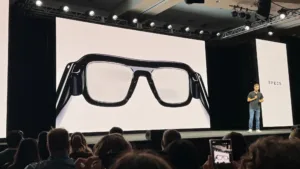
Sunkubo: Immediately after the keynote speech, Snap, the biggest sponsor of this year’s AWE, was revealed. The entire corridor leading to the keynote venue was filled with Snap’s exhibits. Snap unveiled the production version of their AR glasses, “Specs.”

Sunkubo: Up until now, it had been provided as a prototype for developers, but the release of the production version was announced at AWE a year ago, and now the release in the fall of 2026 and the start of pre-orders have been announced. The set includes two lenses, has a 51-degree field of view, and the charger is USB Type-C compatible. In his keynote speech, Snap founder and CEO Evan Spiegel emphasized that they have obtained 7,000 patents and said that other companies cannot imitate them. The venue was buzzing with excitement.

Yuriika: So it’s a very tense situation there.
Sunkubo: Meta has been developing AR glasses called Orion for about two years now, but it seems there’s been some intense behind-the-scenes fighting over patents. Snap has taken the lead in showcasing their product. The price is $2200, and pre-orders started on the day of the announcement. However, it’s only available in select regions such as North America, the UK, and France, and Japan is not included at this time. I actually tried entering my address on the site, but I couldn’t place an order.
Yuriika: They look like bulky glasses, don’t they?
Sunkubo: That’s right. At the venue, you couldn’t actually touch the device; there were only souvenir-type items that gave you a sense of the atmosphere. We don’t know yet how well it performs as AR glasses. When the CEO appeared in the exhibition area after his keynote speech, it became a hot topic on social media. While there were positive reactions to him actually wearing them, there were also negative comments that the design was still too big, so opinions were divided. Just at that moment, cheers erupted outside, announcing that Mexico had won 1-0.

The strength of a standalone system
Sunkubo: To put it another way, what sets Specs apart from other AR glasses is that it’s standalone. It’s not connected to a computing pack via a wire, nor does it wirelessly connect to a smartphone to handle processing. Many recent smart glasses connect wirelessly to smartphones and handle processing on the smartphone side, so they aren’t strictly standalone, but Specs is different. I think Specs is the first to be completed as a computer in the form of glasses.
Yuriika: Up until now, there have been HoloLens and XREAL from HMS in Japan, but they were bulky and more like glasses. In comparison, Specs weighs about 130 grams, which is heavy for glasses, but it’s quite light compared to a headset.
Sunkubo: In the sense that we’ve finally perfected the form of AR glasses, you could say we’ve reached the very limit of what’s possible. There are some imperfections, such as the thick frame, but the battery life has increased by about eight times compared to the original Spectacles development version (around 30-40 minutes). It’s a significant improvement over the past two years or so. The appearance is also much sleeker. The price won’t be sold in Japan, so converting it to Japanese yen isn’t very meaningful, but it would be around 350,000 yen. On stage, they said it wouldn’t be as expensive as the Apple Vision Pro.
Yuriika: I don’t know about the way you put it.
Sunkubo: AWE itself is a niche event even within the industry, so there are many years when there aren’t any announcements that attract attention from the general media, but in that sense, I think Snap’s Spectacles was the most attention-grabbing announcement this year.
XREAL officially announces “Aura”
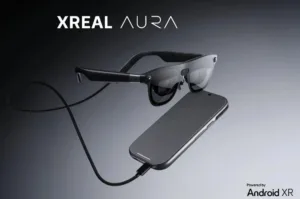
Sunkubo: Another big announcement is XREAL Aura. This is the official announcement of “Project Aura,” which has been jointly developed by Google, semiconductor manufacturer Qualcomm, and XREAL. The name remains Aura, and they decided to keep it as the product name because the response within the company was positive.

Sunkubo: Up until now, XREAL had made announcements on its own, but this time it was unveiled during Qualcomm’s keynote speech, with XREAL’s CEO Xu and a Google representative taking the stage. It operates by connecting to a computing pack via a wired connection. This was already announced at Google I/O (Google’s developer event) in May, and Nishida Munechika, a writer for Mogura VR, published a review and interview about it, and this is the product version of that. At the experience corner in the venue, hand tracking also worked, and the movements were very crisp, and I felt that the quality was completely different from previous models such as the XREAL Air 2 Ultra. The field of view has been expanded to 70 degrees.

Yuriika: That’s quite an increase.
Sunkubo: Weighing just 93 grams, it’s under 100 grams, offering the same comfortable fit as the XREAL Air 1 and Air 1 Pro, while still providing hand tracking and spatial awareness. XREAL has recently adopted a system where a dedicated chip is built into the glasses themselves, allowing sensor information to be processed within the glasses, thus reducing latency. In addition to the new chip, the computing pack will also be equipped with Qualcomm’s new chip, “Snapdragon Reality Elite.”
Yuriika: And it also runs on Android XR, right?
Sunkubo: That’s right. Since it runs on Android XR, you can use Android apps, and we can also expect compatibility with apps for the already released headset-type device, “Galaxy XR.” Another difference from previous XREAL projects is that we are working with Google on this one.
Yuriika: Japan has been added to the list of countries where the device is scheduled to be shipped, so it will be an Android XR device that can be properly experienced in Japan.
Sunkubo: In Japan, the headset-type Galaxy XR hasn’t been released yet, so the XREAL Aura will be the first Android XR device in Japan. Gemini was also emphasized when I interviewed the CEO. It is said that combining AI with AI in general has potential, but the AI functions of Ray-Ban Meta’s Meta AI, for example, are not yet sufficient. The XREAL Aura and Android XR are planned to be equipped with Google’s Gemini, and it is said that you will be able to operate it by talking to Gemini while wearing the glasses, or launch apps. However, we were not able to experience the Gemini function on the XREAL Aura at the venue.
Sunkubo: On the other hand, exhibited next to it was a prototype of smart glasses with a display that supports Android XR. Google has recently been calling them “intelligent eyewear” rather than “AI glasses,” and this is a type with a display, not a Ray-Ban Meta type without a display, so it is a product that is similar to the Meta Ray-Ban display. I was able to actually try this out. Compared to the Meta Ray-Ban display, it is lighter and looks sleeker, and it gave the impression that they have worked hard to make it small and light. It is still a prototype, but it supports full color display. With navigation linked to Google Maps, the guide is displayed when you are looking straight ahead, and the map is displayed when you lower your gaze, and it is linked to the movement of your head (3DoF head tracking). The action of lowering and raising your gaze when walking while looking at a map on a smartphone is completed with the glasses, which I found subtly impressive.


Pricing and booking system
Sunkubo: The only thing that’s a little hard to understand is the sales method.
Yuriika: It’s a somewhat unusual system, where you sell the sales rights.

Sunkubo: It seems they’re struggling with the price. Snap has already announced a price of $2200, but XREAL’s upper limit is $1500 in dollar terms, and they actually want to make it around $1200. They’re currently wavering between the two, and due to factors like memory prices, they can’t decide yet. However, they have made the announcement, and are offering early access to priority shipping rights and discounts for those who want one. The “Founder Priority Pass,” which grants top-priority shipping, is $299 (approximately 45,000 yen in Japanese currency) and is limited to 2000 units worldwide. The “Launch Credit,” which offers a discount, is $99 (approximately 15,000 yen in Japanese currency) and also ships slightly earlier. These amounts will be applied as discounts when the actual pre-orders begin, making it a somewhat confusing sales method. Apparently, 2000 Founder Priority Passes have already been sold.
Yuriika: It’s the kind of product that will appeal to people who will buy it based on its performance alone, without even looking at the price. I’m glad that Japan is included in the shipping target.
Sunkubo: XREAL has always said that Japan is an important market with many developers, so we have included it as a target country this time as well. On the other hand, Snap does not include Japan in its target market, so it will be difficult to obtain in Japan and it will be difficult to set up a development environment there. Both are scheduled to be released in the fall of 2026. AR glasses are positioned as the highest-end products among AI glasses and smart glasses, and they are expensive, going beyond simple display and camera functions to include the realm of AR. There has been movement in this highest-end segment this year, so looking at smart glasses as a whole, it can be said that the battle has already begun in segments that are not just camera-equipped or display-equipped.
The Importance of the New Chipset “Snapdragon Reality Elite”
Sunkubo: The announcements for Snap and XREAL are hardware, so they tend to get a lot of media attention, but what I think is important is Qualcomm’s new chipset, “Snapdragon Reality Elite,” which I briefly mentioned.

Sunkubo: Qualcomm has previously offered the “Snapdragon XR1” and “XR2” series for standalone headsets such as Meta Quest and PICO, and smart glasses like Ray-Ban Meta, but Reality Elite has been introduced as a complete overhaul of these. I think the fact that they have deliberately changed the name and refreshed it from the previous top-of-the-line XR2+ Gen 2 is because there are significant changes. It is said to support up to 90fps at a resolution of 4.4K per eye, and the GPU, NPU (processor for AI processing), and CPU performance have all been improved compared to the previous XR2+ Gen 2. On-device AI also operates more smoothly, and power consumption and heat generation have been reduced.
Yuriika: So that means a device designed for 4.4K will be released somewhere in the future, right?
Sunkubo: I think so. The XREAL Aura’s resolution is limited to Full HD per eye, so there should be other devices that can take full advantage of the Reality Elite’s specifications in the future. It may be included in PICO’s “Project Swan” currently under development, or in Meta’s next-generation devices. They also explained that the video passthrough image quality is better than Apple Vision Pro.
Yuriika: Vision Pro is already beautiful to begin with, so it’s something you can only really tell by trying it out.
A program to support the development of AI-powered devices.
Sunkubo: There were hundreds of sessions. In Qualcomm’s presentation, in addition to talking about Reality Elite for AR glasses and headsets, they also talked about chipsets for smart glasses and announced a support program called “Turnkey Scalable AI Toolkit.” This is an initiative to provide sample chipsets and complete software packages to hardware manufacturers who want to create AI-based devices.


Yuriika: It’s an encouragement to developers to create more AI devices.
Sunkubo: That’s right. There’s quite fierce competition in this area behind the scenes. Semiconductor manufacturer Materials Applied has also announced a program called “Sense,” which brings its own optical system to the “waveguide” technology used in smart glasses with displays, and is working in conjunction with Qualcomm chipsets and collaborating with eyewear brands such as Ray-Ban and Oakley. They are reportedly producing prototypes of single-eye and double-eye models in collaboration with assembly manufacturers such as Taiwan’s Quanta and Pegatron. Pegatron also made smart glasses with Japan’s Cellid last year. Since they are a company that handles the assembly of eyeglasses, it seems they are working with various companies by changing their partners.

Unique technologies found on the exhibition floor
Sunkubo: TDK from Japan also had a booth. TDK supplies sensors for smart glasses, such as the mechanism that automatically turns on the Ray-Ban Meta when worn, as well as sensors for turning the power on and off by opening and closing the temples, and for volume control. Apparently, 80% of smart glasses currently on the market use TDK sensors.
Yuriika: I’m surprised it has such a large market share.
Sunkubo: They also had a product called “Prism Raven” on display.


Yuriika: It had eye-tracking capabilities, right?
Sunkubo: That’s right. It runs Linux and can operate independently without a smartphone. The interesting thing is that the battery is swappable and can be removed and replaced.
Yuriika: Rokid’s AI glasses also have models that allow you to attach an additional battery, right?
Sunkubo: There were indeed many Chinese manufacturers exhibiting smart glasses, and it seemed like there were slightly fewer than last year, but there was still a wide variety. Another unique item was a video passthrough type MR glasses from a Valley Silicon company called Ant Reality. It looks similar to AR glasses, but the upper half has a structure closer to an MR device. It weighs only 93 grams and is very compact. It was developed by a team of only 12 people. In addition to being able to connect to a PC or smartphone for extended screen display, they said that with a dedicated app it is also possible to fix the display in space with 6DoF.

Yuriika: So it can be used as a small mixed reality headset, right? I think a lot of people would want one.
Sunkubo: Canon also had a booth again this year. Canon handles MR headsets like MREAL and camera lenses for Apple Vision Pro, but this time they were exhibiting waveguide technology using their own proprietary micro-OLED, with an eye towards AR glasses. The brightness is very high at 15,000 nits, and the field of view is 30 degrees. It is positioned as a proposal for elemental technology, which is different from the micro-LEDs (not inorganic EL, but liquid crystal type) currently on the market.

Trends in location-based entertainment and its industrial use
Sunkubo: HADO, a VR sport originating in Japan, also had a booth, and it was announced that HADO USA has officially launched. This time, there were also many lectures and exhibits related to location-based entertainment (LBE, a format experienced at a specific facility). The escape game-type content, which can be experienced by up to 6 people in a 6-meter square space, has expanded to 250 locations worldwide through franchising and supports about 8 languages.

Sunkubo: Location-based services are increasing in Japan as well, but it seems to be a global trend. What surprised me the most was that there was an exhibit combining blood donation with a booth using the Galaxy XR.

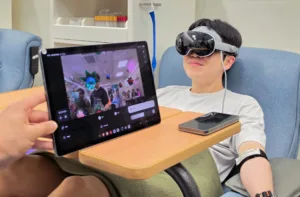
Sunkubo: It was the first time I’d seen a blood donation booth inside a venue. Blood donation involves sticking a needle in and drawing blood, so many people tense up at that moment. I was told that the MR experience was introduced to alleviate that anxiety and have a relaxing effect. It seems that it’s already being rolled out in several locations. It’s a similar idea to showing VR images to dentists during treatment. Yamaguchi, the CEO of Synamon, was also there and apparently tried it out and posted about it on Facebook. He commented that he “didn’t mind it at all.”
New developments in 4D Gaussian splatting
Sunkubo: Spanish startup Gracia also exhibited again this year. Gracia is working on “4D Gaussian splatting,” which adds a time element to “3D Gaussian splatting,” a technology that captures real space as a collection of points. Their announcement this time was that their content, which was previously compatible with smartphones and Meta Quest, will now also be compatible with Apple Vision Pro.


Yuriika: It looks like it would look best on Vision Pro.
Sunkubo: A Meta employee, who is collaborating with Gracia on content creation, was also present at Gracia’s presentation. He was a Japanese national named Matsuda, who works in Meta’s Reality Labs (research and development division). He said that he had been struggling with technical limitations in his efforts to volumetrically capture space (a technology that records people and objects in 3D) when he met Gracia, which led to their collaboration. They are working on a new type of content creation, recording a stage where a DJ plays music and people dance, not only the people but also the space itself, using 4D Gaussian splatting.
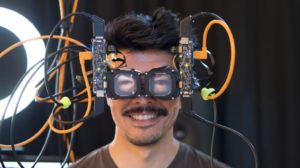
Yuriika: Meta previously worked on something called HyperScape Capture, but that didn’t involve any movement. This time, it seems like an evolved version of that.
Industrial applications are moving from the “introduction phase” to the “full-scale utilization” phase.
Sunkubo: In addition to LBE sessions, I also attended many B2B-oriented sessions. Case studies from various industries, such as steel and rescue team training, were presented, and the factors behind success and failure were discussed. Many of the sessions had small audiences, but I personally learned a lot.

Sunkubo: The idea that VR can be used for training has been around for years, so there’s not much to learn from just hearing that now. However, this presentation focused on cases where implementation has already progressed. Examples were presented with 20, 50, 100, 200, and even 2000 headsets, giving the impression that they’ve moved beyond the trial phase and entered the full-scale operation phase. There are still many cases in Japan where implementation is stalled, so there was a lot of useful information to learn from.
Yuriika: In Japan last year, I interviewed various case studies for a series in Meta, and while some have been successful for a long time, others are still at the idea stage and being explored. It seems that the level of seriousness is a step ahead in Europe and the US.
summary
Yuriika: So the main attractions of this year’s AWE were Snap and XREAL.
Sunkubo: Although the exhibition was smaller in scale, the enthusiasm of the remaining exhibitors and visitors was high, and I felt that the content was relatively consistent. We plan to introduce the lectures and trends in more detail at future debriefing sessions. In addition to the interviews that have already been published, Mogura VR will continue to publish AWE-related reports.
Yuriika: If you have a topic you’d like us to talk about, please contact us through the form. Thank you again for today!