
In July of this year, Even Realities, a smart glasses development company based in Shenzhen, China, completed a Pre-B funding round led by Meituan and Tencent. This reportedly raised $150 million and brought the company’s valuation to $1 billion.
Even Realities is a company that currently offers the AI-powered smart glasses “Even G2.” This device can display information using green letters and symbols on the lens’s display, and when combined with AI functionality, it can be used for a variety of purposes, such as daily schedule management, information display, real-time translation, and map navigation. The design is also very sophisticated, and it is a device that can be worn naturally without feeling like a gadget in a good way. Currently, they are also operating “Even Hub,” a platform for developers to create apps and services that utilize this device, and various apps are being experimentally deployed.
On the other hand, looking at the smart glasses market as a whole, competition is rapidly intensifying, including among major companies. Meta expanded the availability of its smart glasses, “Ray-Ban Meta,” to Japan this year. Google and XREAL are also planning to jointly announce “XREAL Aura” this fall. In this context, what kind of philosophy and strategy will Even Realities, a smart glasses startup, pursue to expand in this field?

(Wang Will: The photo was taken during a previous interview.)
This time, we spoke with founder and CEO Wang Will about the details of their fundraising.
What’s the next strategy based on the funds raised?
Even before the interview, Wang explained the fundraising process to me in his own words.
Wang: Meituan, the company that provided funding this time, is a company that provides services such as food delivery and taxi ordering in China. They are actively expanding their business globally, so there are many synergies (for Realities Even) as well. With the completion of this fundraising, we now have the resources to continue investing in building a competitive advantage.
We are beginning to further strengthen our investment in optical displays in particular. In the development of the Even G2, our primary focus was on providing the highest quality optical display with the lowest power consumption. Unlike our competitors, that is our focus. Therefore, you can expect even greater improvements in optical displays in our next-generation products.
Software development is also crucial. We’ve expanded our software team by about 3 to 5 times compared to before. I think our main focus for software investment will be on three areas.
The first goal is to build a better platform experience that is “easier for developers to develop on.” We launched “Even Hub” three months ago, and so far it has been very active, with many community members and developers developing on it.
The second is improving the AI native experience and agent experience. The conversational function itself is an example of an agent, and needless to say, we are putting a lot of effort into refining the entire Even AI experience. Therefore, we are investing heavily in our own agent experience.
The third point concerns the overall stability of the software. For the first one to two months after the product’s launch, there were some instability issues, such as bugs, disconnections, and occasional freezes. Therefore, we have invested a considerable amount in fixing these problems and optimizing the experience for the best possible outcome. We are increasingly confident in our investments in all aspects to remain a leader in this category.
— Once again, congratulations on raising funds. This was very big news for us as well.
Wang: I think we’re surprising people in the industry, even though we’re a very young team and company.
—Wang, you always seem incredibly busy. I imagine you have very demanding days dealing with investors and supporting your partners. How do you manage to keep everything running smoothly?
Wang: I certainly lead a busy life. I deal with investors and support partners, but I still handle almost 100% of our company’s interviews. This takes up a lot of my time.
One thing that helps me stay focused is always planning ahead. I always have a clear roadmap of what I want to achieve for the next quarter, the next six months, and next year. As long as the roadmap is clear, I can deal with obstacles along the way. Even when unexpected things happen, as long as I feel like I’m moving in the right direction, that’s what keeps me going the most.
My advice is to always maintain a long-term vision, and then break it down into smaller, manageable steps.
–My first question is about the collaboration with Tencent. What are your thoughts on the integration of Even with WeChat (a large-scale Chinese communication app provided by Tencent)?
Wang: Tencent has been one of our main investors since the early rounds, and they have invested even more in this round. They are a very important strategic partner for us. Many of these discussions are still in the early stages, as we are currently selling in mainland China as well. Even before returning to the Chinese market, integrating WeChat and enabling WeChat chats on Glass will be a very powerful feature. We are also exploring partnerships with other messaging app service providers to see if we can roll this out globally.
–In your explanation of the fundraising earlier, you mentioned increasing investment in optical displays. I recall that Even Realities’ initial mission was simply to “make great glasses for everyone.” Given that, is this current approach prioritizing displays part of a short-term strategy, or is it part of a long-term vision?
Wang: We definitely see it as a long-term focus. Of course, if we’re talking about other components, there’s a possibility that we’ll add more in the future, and as the product evolves, we’ll also have the ability to add more features without sacrificing much. But for us, the display will always remain the most important component for smart glasses.

One reason is that it (optical display technology) is the most difficult technology. Smart glasses can always have cameras or speakers added if needed. That’s not difficult, and it’s a very mature technology. However, optical displays are new to this industry. Smartphones and smartwatches have never used them before. If you want to make sure it works with the right quality, this is an area that really requires investment. Before us, there were no waveguide-equipped smart glasses that were suitable for people to wear every day. When you consider something that can be worn daily or used as an alternative to prescription glasses, nothing on the market was suitable.
We have made great efforts to ensure that the lens quality, coating, weight, and ergonomic design are excellent, but when compared to the best prescription glasses, there is still room for improvement and gaps exist. This is also true for optical quality, display function and quality, color, etc.
Therefore, in this field, we will always focus first and foremost on solving optical display technology problems. Furthermore, it is important not only that displays information, but also how they interact with the user.
When Apple unveiled the iPhone with its full-screen display, it also meant the arrival of a multi-touch screen device that was easy to interact with. The ability to comfortably view and operate the display is why we launched the G2. It has now become an essential product for almost 100% of G2 users, and we believe it provides a comfortable display experience.
—So, does that mean you’re prioritizing smart glasses as an output device rather than an input device?
Wang: Input devices like microphones are necessary for things like translation to function. However, we don’t think they should remain just input devices. Because if they are just input devices, their uses are limited, and they become merely accessories for smartphones and AI agents. We believe they should be more than just accessories; they should be platforms that people interact with.
For a platform to be effective, both output and input are important. However, sometimes I think output is even more important. This is because visual output is necessary, and a display of sufficient quality is required to work. Whether it’s an iPad or a laptop, they all need a screen. Moreover, that screen needs to be quite large enough to be productive. That’s why I feel a good display is essential.
—What about speakers? I think audio is a powerful means of providing information.
Wang: We believe speakers are important. We’re not against speakers. We’re cautious about including cameras from a privacy standpoint, but everyone likes speakers. It’s just an engineering trade-off.
Can we maintain a slim profile while adding speakers? Can we keep power consumption low? Can we maintain the weight? We’ve experienced these trade-offs. In the future, as technology advances, we believe the time will be right to add speaker modules, but we are also being very cautious. It would be very easy to simply incorporate commercially available speakers, but then the G2 would become something nobody would want to wear.
—I actually use Even G2 regularly myself, and I think the idea of interacting with smart glasses using the R1 ring controller is fantastic. Do you think a ring controller worn on the finger is the optimal way to interact with smart glasses? Or do you have other ideas for the future?

Wang: Ring The is excellent, and I think it’s the best hardware for operation. You can use it no matter where your hands are, and you can use it without attracting too much attention. You can operate it in a conference room without being noticed or disturbing anyone. You can even do it with your hands in your pockets. So it’s definitely an area where we will continue to invest. Of course, the current R1 controller isn’t perfect, but it’s a good starting point.
There are still many features we can add, such as ways to make things smoother and increase the freedom of operation. We also have an IMU system that allows control with hand gestures. Furthermore, voice control is undoubtedly important. As all experiences become more integrated into the environment, we are exploring ways to make voice control even more powerful through hardware and software redesign.
–Let’s move on to the topic of AI. With the integration of Android, Gemini, and other technologies, smart glasses are becoming the eyes and ears of multimodal AI. How do you think the integration of AI and smart glasses will evolve in the future?
Wang: First and foremost, AI is the core of smart glasses and will undoubtedly be the central pillar of the entire operating system. This is because the glasses will become more integrated into the environment and understand context. You’ll be able to tag them in Slack or LINE and add code, and do all sorts of things. We feel that the overall way we interact with agents is still constantly changing.
Therefore, while terminal mode is a good starting point, it’s not yet the perfect way to interact. This area is constantly evolving, and we are always searching for the best way to interact with AI.
—What are your thoughts on supporting Even G2 in MentraOS (a comprehensive platform for smart glasses)?
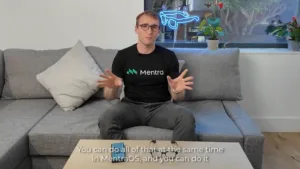
Wang: They are an independent team trying to develop their own OS and software. There is no formal agreement between them and us. We know they are trying to support G2 and are trying to get their software working through reverse engineering, but their software is not on Hub Even. We are not trying to hinder them, but we are not recommending them either.
—Given your focus on AI-driven information transfer, it appears you favor smartphone-connected models over approaches like spatial computing. What are your thoughts on the form factor and functionality of future smart glasses?
Wang: I believe future form factors will be an extension of G1 and G2. I think the current form factors in architecture and systems are a very good starting point, and many aspects will be improved in the future. Glasses will focus on input sensors, but it is the right direction for much of the computing to be offloaded to smartphones.
While devices may become more spatial in the future, they won’t take the form of VR headsets. Even G2 already incorporates a spatial experiment with a simple two-layer system. Looking ahead, we want to further evolve this philosophy and utilize displays in an efficient and power-efficient way. The hardware architecture will be useful and productivity-enhancing, rather than an immersive spatial experience.
—Beyond your market positioning of prioritizing smart glasses displays, I believe your own factories and production lines are one of your strengths. Do you have any plans to further expand your manufacturing process?
Wang: That’s a very good question. The majority of this investment will go towards further strengthening our manufacturing facilities. China has a complex supply chain, but we are focusing on the optical part. Our own factory mainly focuses on the optical part, especially prescription lenses. There is always room for improvement in this area, so we will continue to invest in it. Also, regarding waveguides, we currently have external supplier partners, but we do a lot of the research and development in-house. We want to solve the most difficult parts ourselves and be able to give precise instructions before we ask our suppliers to do it.
Furthermore, the factory manufactures all prescription lenses, and each order must be made to order. Therefore, logistics and worldwide delivery are extremely important. As sales increase, we are continuously considering establishing manufacturing bases on a global scale to provide better service. Establishing manufacturing bases overseas could potentially further improve delivery and other aspects.
–thank you very much.