
On June 23rd, Diver-X, a company that develops VR devices and interfaces, held a new product launch event for the media.
The products unveiled at the event were the company’s new glove-type VR controller, “ContactGlove 3,” and the robotics data glove, “ContactGlove 3 Pro.” Additionally, a major rebranding was announced, with the company name changing to “Melt Interface Technologies Inc.” effective July 1st.
This article reports on the press conference, from CEO Sakoda Hiroto’s explanation of the company name change to a live demonstration of the significantly improved new device.
To become a comprehensive company that transcends the XR domain and provides cross-cutting interfaces.

Sakoda, who was the first to take the stage, spoke about the company’s history, future prospects, and the company name change, as the company is celebrating its 5th anniversary this year.
The company has previously been strongly associated with consumer VR devices, such as the “ContactGlove” consumer VR device. However, looking back over the past five years, Sakoda says, “I was drawn not only to VR devices, but also to the aspect of connecting humans with technology.”
Everyday use cases like VR and mice are merely one application among many. We find business value in “how to increase human productivity” and “how to improve the quality of the experience by enhancing connectivity with VR spaces.”


Therefore, to demonstrate that the company is a comprehensive provider of cross-cutting interfaces that go beyond the XR domain, it will change its name to “Melt Interface Technologies.”
This new company name embodies three aspirations: creating a “melt” experience that allows humans to control computers as they wish; focusing on “interfaces” themselves; and being a “group of technologies” that develops various solutions.
Furthermore, while Diver-X has previously been primarily known as a “VR device development company,” it is said that half of its revenue actually comes from its solutions and services business. Sakoda emphasized that this vertically integrated system, from devices to software, is a strong competitive advantage for the company, especially now that AI is leading to the commoditization of application development.

Going forward, the company plans to develop its business based on three pillars: everyday devices like “MeltMouse,” industrial interface products such as the newly announced “ContactGlove 3,” and B2B solutions that leverage its technological capabilities.
While focusing on the unique strengths of their devices, such as haptic feedback and sensing technologies that enable digital transformation in industrial settings, they also expressed their ambition to revolutionize everyday interfaces, such as voice input, rather than sticking to existing devices like mice.

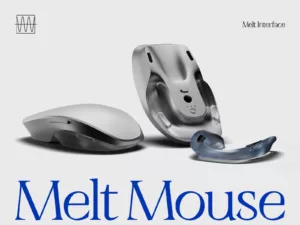
(The “Melt Mouse,” a high-performance mouse for creators, was announced as the first product under the new brand “Melt Interface,” launched in October 2025. The name itself, as well as the tagline, “An experience where your hand completely melts (blends) with your computer,” suggests that the brand’s concept is deeply connected to the company’s name change.)
Diver-X’s strength lies in its ability to “thoroughly consider interfaces and then quickly bring them to life.”

Next to take the stage was Kojima Jun of Boshoku Toyota Corporation, a major shareholder and co-developer of Diver-X. Boshoku Toyota is a company that handles car interiors and is exploring the ideal form of space in mobility as an “interior space creator.”
The company had been using the virtual world to reduce development costs and verify user experiences for some time, but they faced the challenge that “with VR goggles alone, it’s impossible to touch objects, making it very difficult to understand distance and control.”

Therefore, the company focused on Diver-X, which had incorporated tactile feedback technology for fingertips using shape memory alloys from an early stage, and started joint development. Currently, they are using haptic gloves to verify that users can actually touch and operate the car’s interior in a VR space.
When asked why he chose Diver-X from among many companies, Kojima highly praised them, saying, “Led by CEO Sakoda, they are a group that has thoroughly considered interfaces and can quickly bring them to life.”
As a concrete example, Kojima shared an anecdote about a time when he had requested Sakoda to “make something like this.” He said that a demo video was sent to him just two days later, and when he met Sakoda in person the following day, an improved version was already prepared. He said he was shocked by the astonishing speed of development, thinking, “So this is the modern-day Edison.”
Introducing the new “ContactGlove 3” model, which achieves zero drift, and the “ContactGlove 3 Pro,” which aims to become the world standard for robot teaching.

Next, Kazami Takashi, Head of Sales and Marketing, announced the exciting new product, “ContactGlove 3.”
The product concept is “Beyond Limitations.” The most distinctive feature of the new ContactGlove is its revolutionary sensor system, utilizing proprietary “Zero-Drift Technology.”


While the previous ContactGlove2 used a bending sensor method to estimate the bending angle of the fingers, the new ContactGlove employs an electromagnetic field (EMF) tracking method. By using a magnetic sensor, it is now possible to obtain the absolute value of the position of the fingers and hand.
This achieves an astonishing level of accuracy, with a median error of 0.5mm and a maximum error of 1.5mm. It can now more accurately reproduce the subtle nuances of hand and finger movements in virtual space. The issue of drift over time, which was a problem with previous models, has also been resolved, and the system has evolved to the point where calibration before use is only required the first time.

In terms of comfort, the battery has been improved to last 10 hours and has passed rigorous durability tests. The included new controller module, “Magnetra 3,” is also 20% smaller, minimizing interference with your fingers.
Furthermore, the newly added “grip lock button” prevents the grip from being released even if the hand shape changes, solving the problem of unintentionally dropping objects in the VR space. In addition, a dedicated dongle with a 1.2m cable is provided to stabilize the communication environment.
And now, alongside VR applications, another major area that has emerged is its application in “robot teaching” in the industrial sector.

In response to the surge in demand over the past year for “using glove-type devices for teaching general-purpose robots movements and collecting data,” we have developed a new data glove for robotics. That is the “ContactGlove 3 Pro.”
Unlike the open-finger design of the ContactGlove 3, which leaves the fingertips exposed, the ContactGlove 3 Pro features a design that completely covers the fingertips. High-precision fingertip tracking allows for the faithful capture and reproduction of even delicate interactions such as “pinching.” For applications where precise fingertip movements need to be accumulated as AI training data, the ContactGlove 3 Pro can be an ideal choice.
Furthermore, with a view to long-term use in the robotics field, it is designed with expandability that will allow for the addition of options such as haptic functionality in the future. It also provides extensive support for various SDKs such as ROS and Unity to ensure smooth implementation in a variety of development environments.

According to Kazami, the ContactGlove 3 Pro aims to “become the world standard for robot teaching.” Both new products are scheduled for release in October, and pre-orders for the ContactGlove 3 have already begun at the official store.
A robotic hand also made an appearance! A live demonstration showcased the high accuracy of the tracking system.

At the presentation, CTO Asano Kei gave a live demonstration of the ContactGlove 3.
Unlike typical glove-type devices, which struggle with precise fingertip-to-finger contact, the on-screen hand tracks perfectly without any misalignment. Whether it’s the thumb and index finger, or the middle finger, any combination is spot-on.
Furthermore, it perfectly reproduces gestures that were difficult to recognize with conventional optical camera tracking, such as rotating one finger at a time or crossing the index and middle fingers. And best of all, it excels in occlusion (blind spots).

Even when a hand was placed inside a prepared box, completely obscuring the view from the outside, the virtual hand on the screen remained completely unaffected, continuing to track smoothly and accurately.

Furthermore, a “robot” actually appeared in the demonstration. Using ContactGlove, a demonstration was also given in which a five-fingered robotic hand called “OmniHand” was controlled in real time. Asano When moved his fingers, the robot’s fingers moved in the same way.
Based on this demonstration, Asano explained that “a market is emerging for remotely controlling robots and supplying accurate data for teaching.” He predicted that the demand for devices like ContactGlove, which can acquire the high-precision tracking data necessary for this purpose, will increase even further in the future.
 (Based on a demo experience after the presentation. The fit has been further improved from the ContactGlove2, and it feels almost the same as wearing thin work gloves. There is none of the bulkiness often found in cycling gloves or work gloves, and there is absolutely no snagging when moving your hands. With this lightweight and comfortable fit, I got the impression that it would also be suitable for uses such as playing musical instruments.)
 (Due to its design, sensors are not placed on the fingertips except for the thumb, so there were times when stiffness was felt when making fine movements that fully utilize the first joint. However, even taking that into account, it is clear that it can track even the fluid, flexible movements of human fingers.)
The future shaped by the “interface” that the new company name represents.

As Asano also mentioned, the demand for high-precision data collection for robot teaching is rapidly increasing worldwide. Hand tracking technology, which can accurately digitize even the subtle nuances of fingertips, is indispensable for achieving this.
Until now, “ContactGlove” has been primarily known as a consumer-oriented “VR hand tracking device,” especially for VRChat users. Therefore, the announcement of its full-scale expansion into robotics and industrial applications came as a considerable surprise.
On the other hand, Diver-X has long been a company that focuses on “interfaces.” Sakoda also stated the following in a 2024 interview, and the company’s approach of “applying superior hand tracking and haptics technologies to a wider range of industrial fields” is actually consistent and can be said to be a very natural approach.
Our core focus is “interfaces,” and in the future, we would like to create devices other than VR. So why are we currently focusing on the XR field? Because we feel that this is where the difference in value as an “experience” is most likely to emerge.
For example, using a good keyboard makes you type faster, and using a good display makes images look better. Using a good interface completely changes the experience you get. In other words, using a good interface makes some kind of difference. And it is in that “difference” that customers find value.
When considering things based on those principles, I felt that the XR field was the easiest to create that “difference.” It’s a developing industry to begin with, and VR itself is an experience that involves physical sensations. Just adding a new device can significantly change the quality of the experience. That’s why I think it’s easier to monetize, and that’s why I’m currently working in this field.
(“Technology that doesn’t exist in the world today” to the world: What kind of human augmentation implementation is Diver-X challenging itself to implement? – Mogura VR job)

The ContactGlove 3 has evolved beyond being merely a VR device into a “versatile interface” that can be used in a wide range of fields. This transformation of the product perfectly symbolizes the philosophy behind the company’s rebranding, which changed its name from Diver-X to Melt Interface Technologies and aims to become a comprehensive company that dissolves the barriers between people and technology.
As Sakoda describes, “a world where the boundaries between humans and technology melt away through devices, leading to improved quality of life and productivity,” the company has taken a powerful step forward with its new name, and we will continue to keep a close eye on its future endeavors.
