
XR Hub Kaigi Osaka 2026 was held in Osaka from September 9th to 10th, 2026. One of the sessions was a presentation by Ishimura Takuya of Equipment Ishimura Planning J/HoloLab Inc. entitled “Firefly The Squid Project: Personal From Development to Collaboration with the City – Local Addressing Issues with XR.” The presentation described the process from bringing VR to the site as an individual, to its permanent installation, and then to a new permanent AR installation in response to a consultation with the city.
Speaker Introduction: Takuya Ishimura (Ishimura Equipment Planning J / HoloLab Co., Ltd.)

After working in pharmaceutical sales and as a plumber, he became fascinated by Unreal Engine. As a personal project, he started an XR exhibition themed around firefly squid. He is also an ambassador for the Firefly Squid Museum.
The Firefly Squid Project: From Individual Development to Collaboration with the City — Addressing Local Challenges with XR
Ishimura began by saying, “In this lecture, I won’t be talking about elemental technologies at all. Instead, I’m going to talk about the down-to-earth aspects of how to get what I’ve created to take root in the local community.”
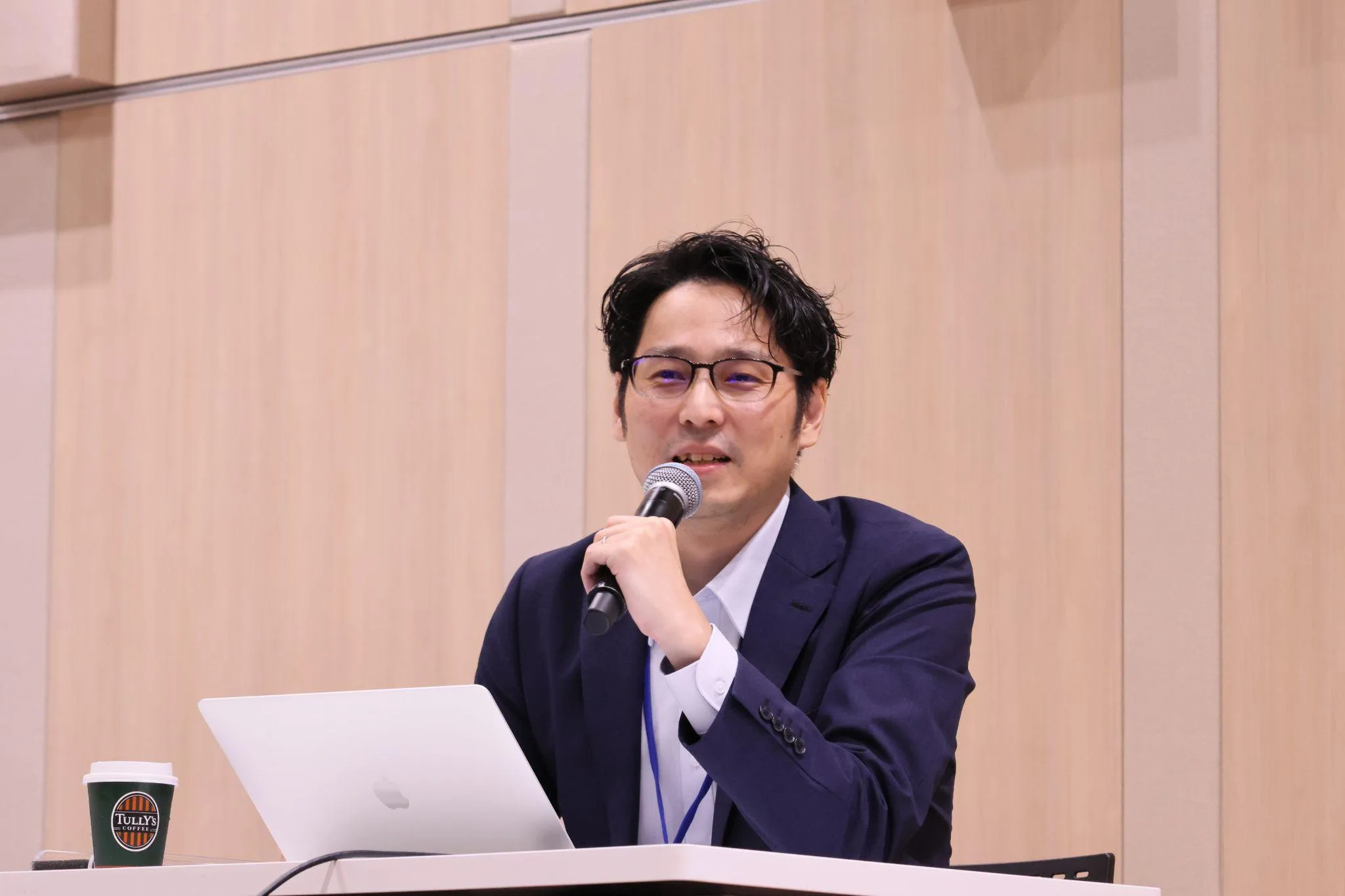
Ishimura encountered Engine Unreal while working as a plumber in Prefecture Toyama, and while enjoying development, he found himself working at HoloLab. He currently serves as an ambassador for the Squid Firefly Museum.
How do we resolve the question, “Are there no firefly squid here?”
The “Squid Firefly Museum,” for which Ishimura serves as ambassador, is a facility that opened on March 27, 1998, in City Namerikawa, Prefecture Toyama. It is a museum that focuses on firefly squid and will soon celebrate its 30th anniversary.
The challenge this facility had faced for many years was the season. Live firefly squid can only be displayed from March 20th to the end of May. This period is called the on-season, and exhibits that allow visitors to touch the squid and bioluminescence shows are held, resulting in a surge in visitor numbers. On the other hand, from June 1st to March 19th, live firefly squid cannot be seen at the facility. How to make the facility appealing for most of the year without the main attraction being alive? That was the facility’s challenge.
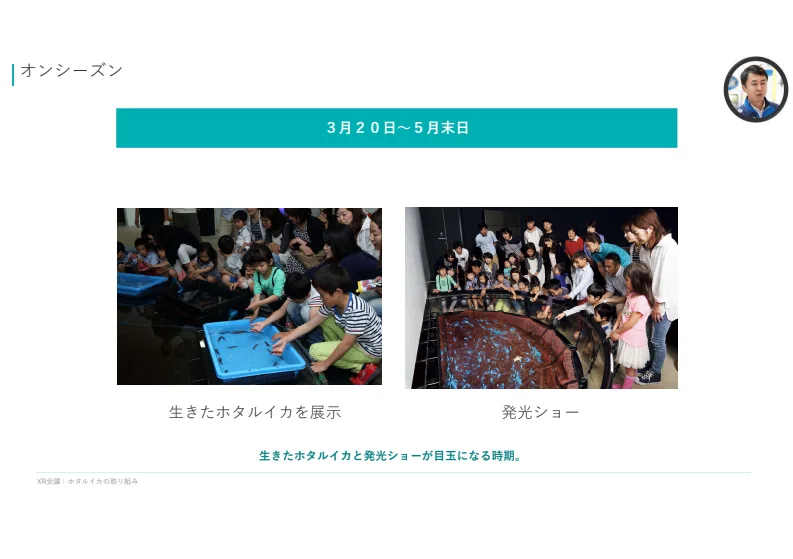
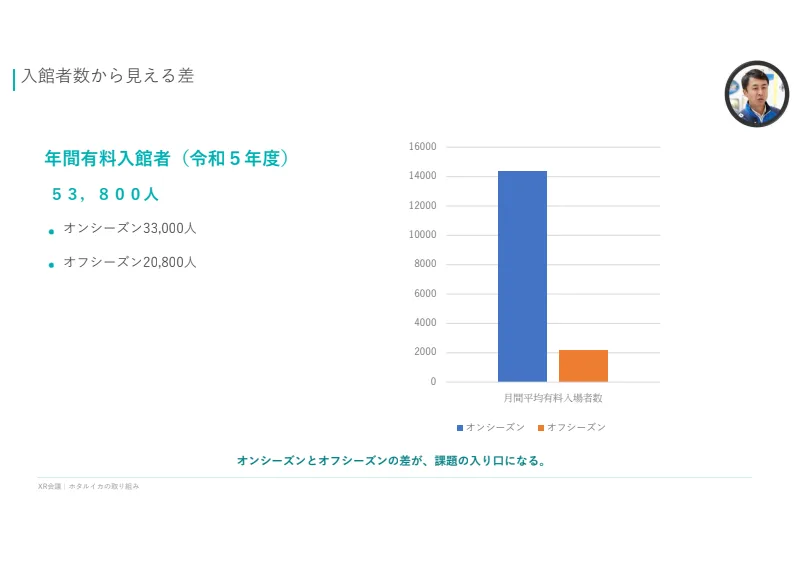
During that time, they exhibit bioluminescent plankton, giant isopods, and garden eels. Kobayashi Director’s policy is to exhibit anything that he finds interesting, and Ishimura explains that it is a facility that wants to do cutting-edge things. Nevertheless, many visitors come to the Squid Firefly Museum expecting to see firefly squid no matter when they come, and they are often asked, “Aren’t there any firefly squid?” The number of visitors differs greatly between the on-season and the off-season.
However, the museum’s stance was positive. They considered the fact that there are seasons when firefly squid are absent to be part of the charm of the ecosystem, and deliberately conveyed this fact without shying away from it. Ishimura described Kobayashi Director as someone who is prepared to face this reality head-on and is not afraid to take on new challenges.
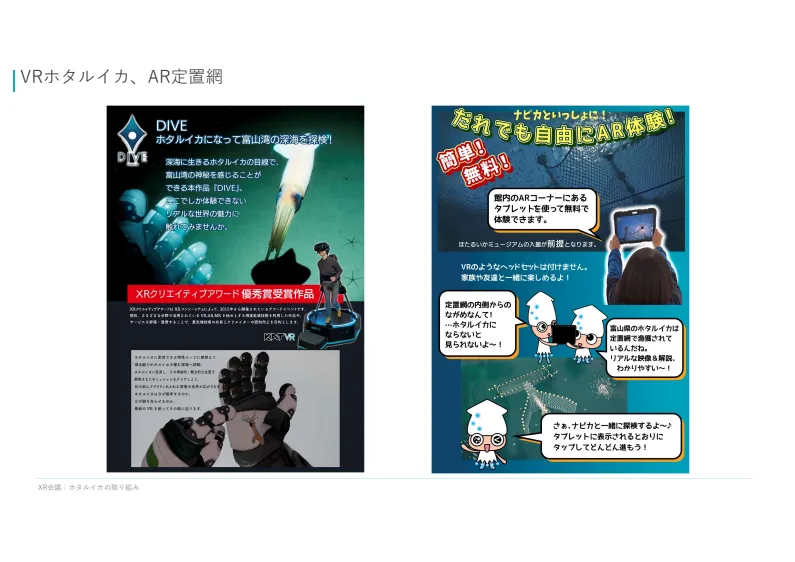
Currently, the museum has two permanent exhibits: “VR Squid Firefly” and “AR Net Fixed.” Visitors can touch the squid using hand tracking, explore the deep sea by walking with a walking device called KAT VR, and freely view the exhibit using augmented reality. The exhibits were developed by Ishimura using Engine Unreal and were made permanent with the cooperation of the museum, City Namerikawa, local fishermen, and local people who have a passion for firefly squid.
It started with, “Please put it on first.”
This introduction might make Ishimura seem like someone passionate about solving local issues, but he denies it, saying, “That’s not the case at all.” His starting point was simply his love for VR and game engines, and his motivation to do something interesting. Now, that has evolved to the point where he’s thinking about urban development. The lecture proceeded with the idea that this transition itself might offer some clues.
When he was a plumber, he created “Plumbing VR,” a virtual reality system for doing pipework. Ishimura says that developing it was “interesting.” However, when he suddenly thought about who it was for, what it was for, and what problem it solved, he couldn’t come up with an answer himself. “Just being interesting won’t change people’s behavior or get you a budget.” Realizing this, he went to a training session in Prefecture Toyama to listen to the challenges of companies and tried to think from the perspective of those challenges. Even then, he jumped at the idea that “XR technology might work here,” and couldn’t escape the thought of whether XR could solve something.
While groping in the dark, I showed a VR device to an acquaintance, who suggested, “Why don’t you show them the mass stranding of firefly squid?” Mass stranding is a phenomenon that can only be seen when the conditions are right, where firefly squid are washed ashore and glow blue. I found the idea interesting and immediately created a prototype. It simply involves placing squid in a tank asset and interacting with them using hand tracking.
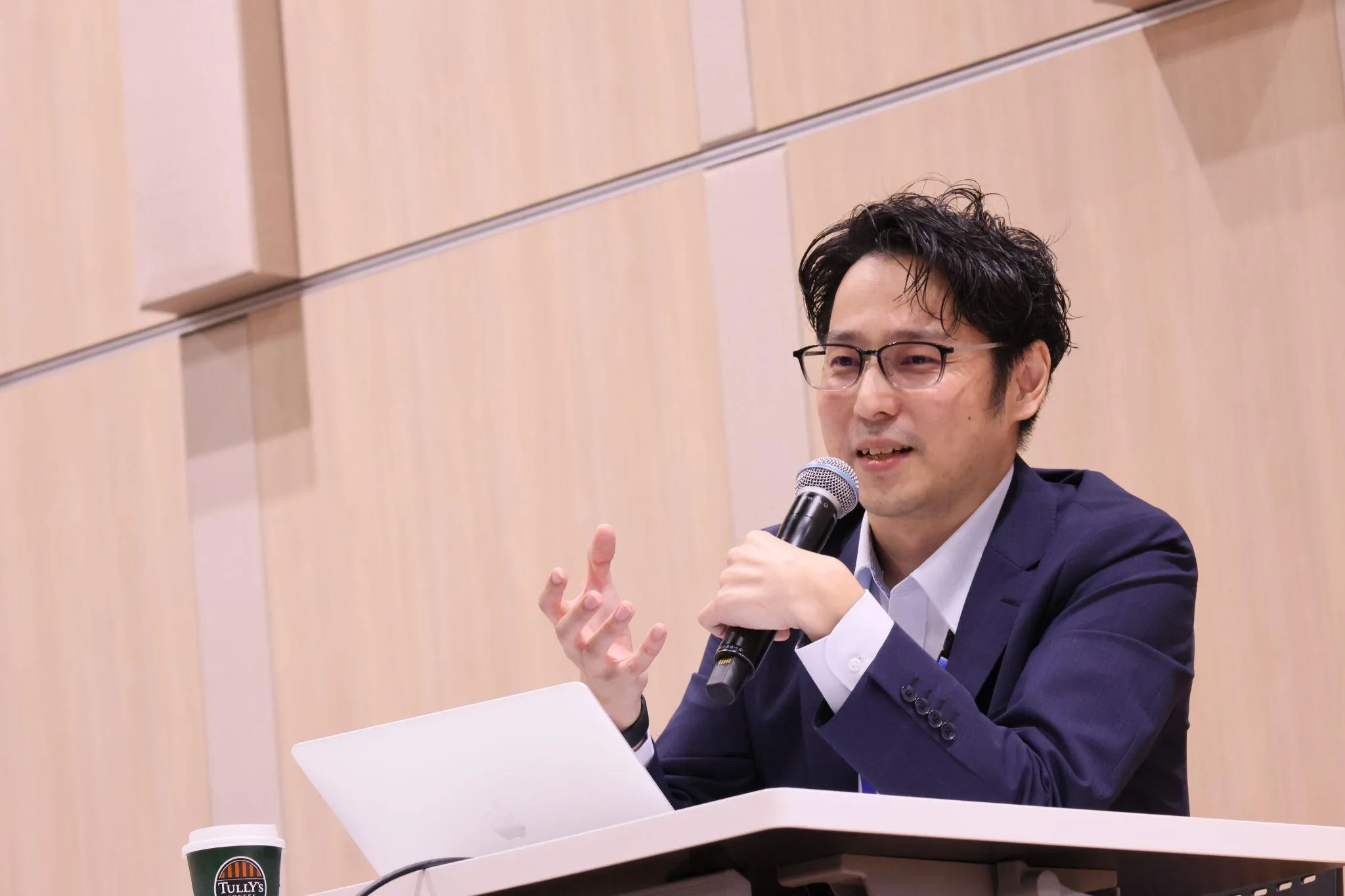
I wanted to show this creation to a professional about firefly squid. However, I was scared to go alone. Through someone from an NPO I met at a local study group, I was introduced to a prefectural assembly member from Prefecture Toyama, and I headed to the museum. I thought I might get scolded for bringing in something I had made without being asked, which was like forcing my ideas on them. The museum director was also skeptical at first. The merits of a VR device can’t be conveyed until you try it on. So Ishimura handed him a headset and said, “Please try it on first.” As a result, the director’s reaction changed completely, and he was surprised, saying, “This is amazing.”
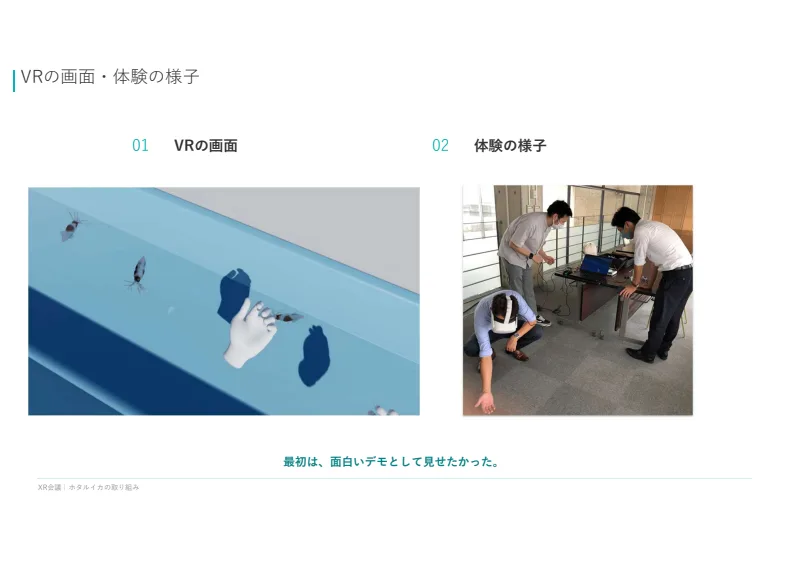
Here, Ishimura gains an important realization. He thought he had gone to show the museum an interesting VR experience. However, Ishimura says that for the museum director, it was a moment when a solution to the problem of not being able to see firefly squid in season suddenly appeared before him. The same demo can be perceived completely differently by someone who has a sense of the problem. The points the director raised were that there were no other VR exhibits in the vicinity and it would be a solution for the off-season, that the museum and the exhibit were both cutting-edge, and that Ishimura was passionate. Passion is indeed important, Ishimura reflects.
How do we overcome the obstacle of “This is not a real firefly squid”?
However, the conversation didn’t proceed as planned. The museum director told them, “This isn’t a real firefly squid.” Ishimura had created an ordinary model of a firefly squid, but those who had been seeing the real thing for a long time noticed something was off. They also said that showing them a non-real firefly squid would elicit harsh criticism.
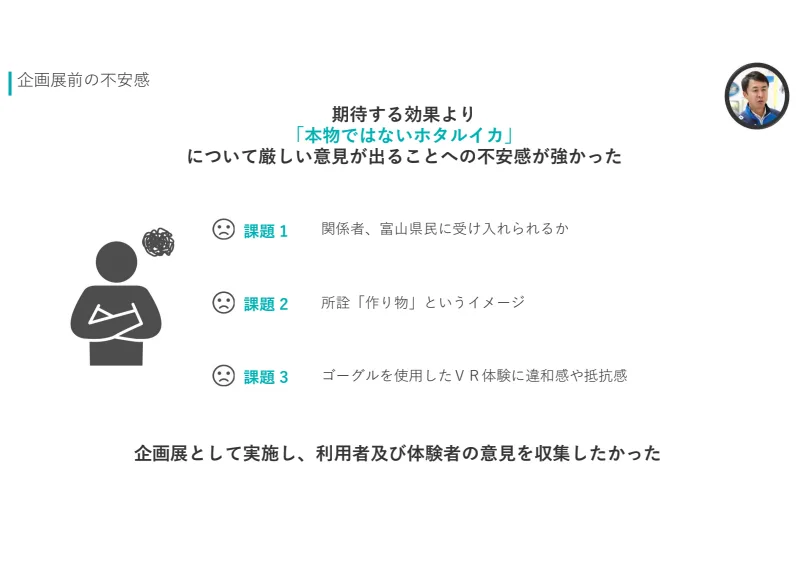
The people of Toyama Prefecture have a discerning eye for firefly squid. When the season comes, they line the shelves of supermarkets, and visiting museums to see them on school trips is a classic childhood experience. If they perceive them as merely artificial, they won’t accept them. There’s also resistance to wearing VR headsets themselves. So, the plan was to first hold a special exhibition and gather feedback from those who experience it.
What began here wasn’t development, but a time spent truly engaging with the firefly squid. With the museum’s cooperation, he frequented the back rooms, spent long hours gazing at the tanks, and stood on the beach at night to watch them jump off the shore. Ishimura says he goes to such lengths because there are things you can only feel on-site, things you can only see by sincerely engaging with the subject.
His research methods were thorough. Firefly squid are essential to tourism and fisheries in Namerikawa City, and a lot of information about them is recorded in the city council minutes. He pored over descriptions of firefly squid using the minutes search system and checked the council videos available on YouTube to see how the issues surrounding firefly squid had been discussed. He went out of his way to grasp the parts that couldn’t be understood from text alone and that couldn’t be found through AI searches. He also read specialized books and history books, tracing back how Namerikawa City has nurtured firefly squid as a tourism resource, and acquired the knowledge and context necessary to stand on equal footing with the other party.
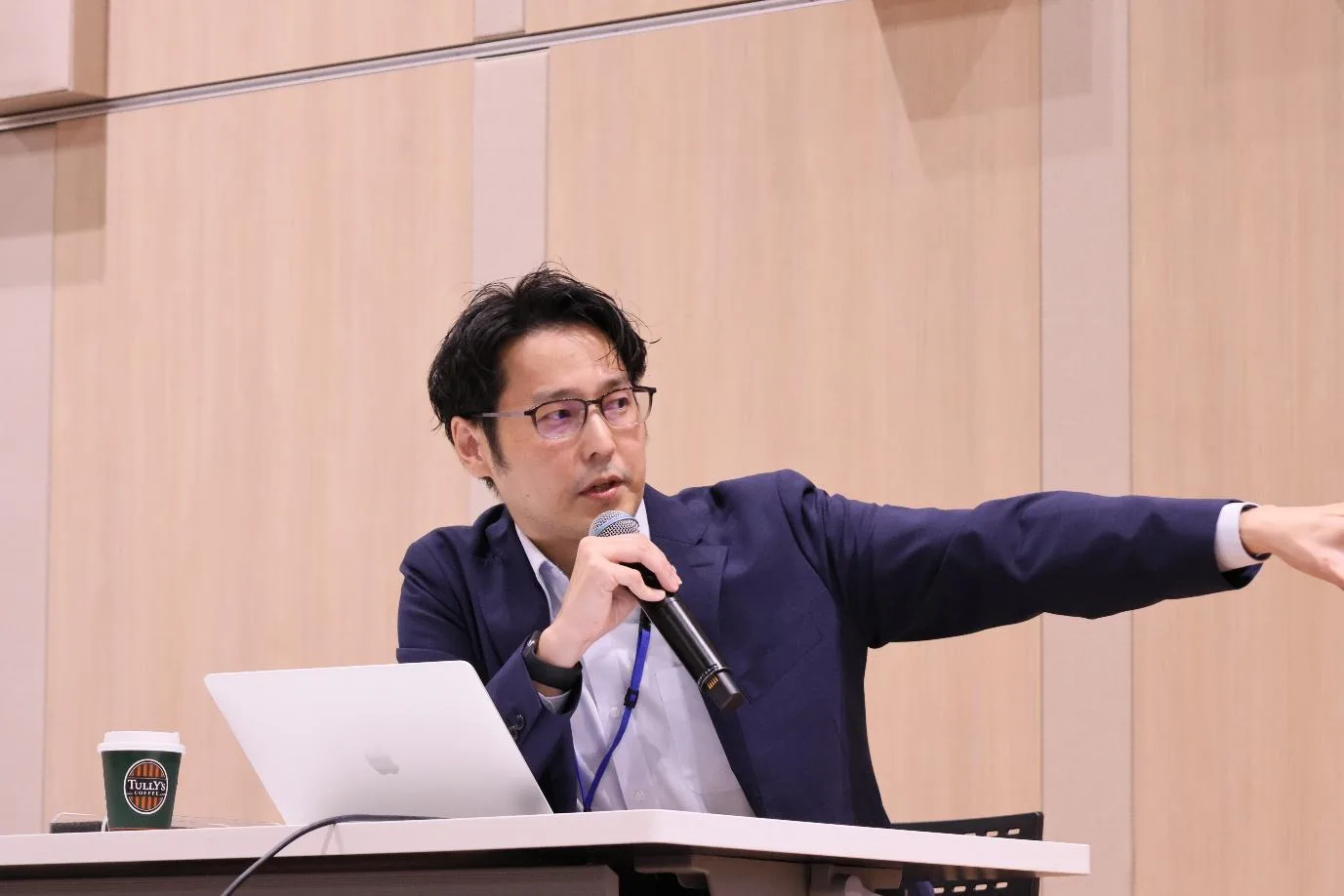
When you understand the problem, your thinking shifts. It’s not “I want to do something with XR,” but “XR is a means to solve the problem.” Firefly squid are not farmed, and they can only be seen alive at the aquarium during the fishing season. Show something that can’t be seen. In that case, XR is the perfect solution.
The content was decided to be a step-by-step approach to realizing impossible experiences, such as “being able to touch seasonal firefly squid anytime,” “witnessing a mass stranding that can only be seen when the conditions are right,” and “going to an inaccessible place, 300 meters deep in the ocean.”
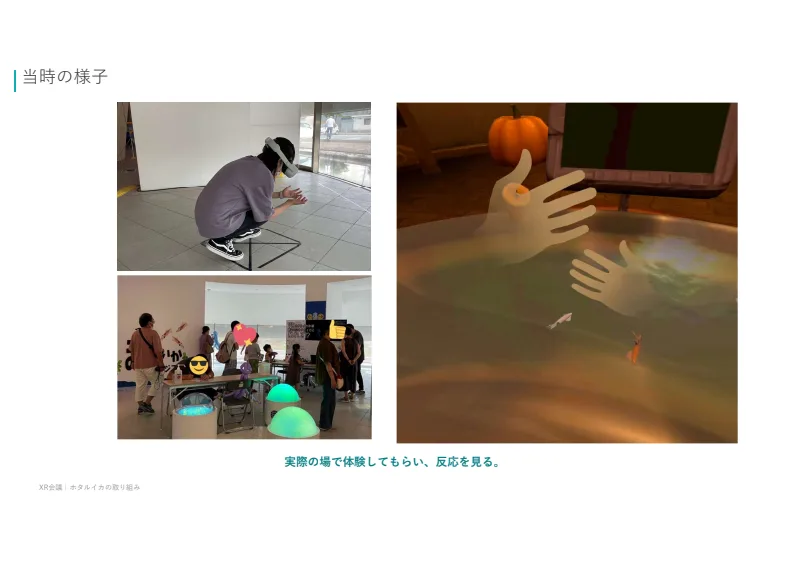
At the special exhibition held during the summer holidays, a firefly squid was featured, with its water-releasing movement, body deformation, bioluminescence, and even arm movements all faithfully reproduced. The curator’s main concern was whether it looked realistic and whether people would enjoy it without any resistance to VR. Approximately 500 people experienced it over 10 days, and about 300 completed a questionnaire. Satisfaction levels were high, but what Ishimura valued more than the numbers were the genuine voices of the visitors. Comments included: “I couldn’t believe it was artificial,” “It felt soft,” and “The bioluminescence was beautiful.” Apparently, some even commented that the water was cold.
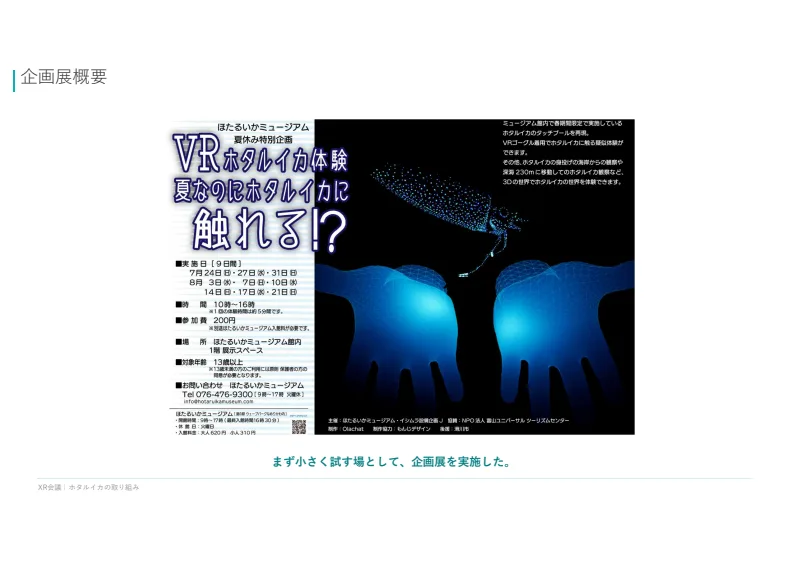
Data also showed that most visitors were experiencing VR for the first time, and many were first-time visitors during the off-season. It was proven that off-season visitors could virtually touch firefly squid without any resistance to VR. Looking back, Ishimura said he thought, “This is more of a PoC (Proof of Concept) than an exhibition.” He also realized that there were feelings of the local people behind the subject matter, and that gave him a sense of responsibility.
You, the creator, should share it in your own voice.
For the permanent installation, the Squid Firefly Museum, the City Namerikawa Division Tourism, Ishimura, and a group of firefly squid enthusiasts formed a team to rethink the exhibition format itself. The previous exhibition followed a structure where people looked at the exhibits, looked at the firefly squid, and looked at the panels. With VR, it’s possible to become the subject, so they thought they could take a position where the exhibits look at the humans. Believing this was a unique appeal that could only be expressed through VR, they decided to move in that direction.
The device chosen for introduction was the KAT VR walking device. There were three reasons for this. First, safety. In the exhibition, there was a scene where a child wearing the headset became so engrossed that they started running and bumped into a wall. It was necessary to have something that would stabilize the body to some extent and ensure that it would be safe even if they fell. Second, VR sickness. Ishimura himself is prone to motion sickness from movement other than warp. KAT VR moves the screen in accordance with the speed of the feet’s walking, making it less likely to cause motion sickness and suitable for people unfamiliar with VR to represent movement. Third, publicity. At the time, the equipment was only available in places like Tower Tokyo, parts of Osaka, and research institutions, so placing it in a regional museum was intended to create an impact.
The director’s decision was also bold. Ishimura reveals that the deciding factors were that there was no precedent for installing KAT VR in a museum, making them the first to do so, and that he was attracted to the contrast of a museum in the smallest city in Prefecture Toyama adopting the latest VR technology. He says that it was because of the museum and the city’s attitude of not being afraid of change and unknown challenges that the team was able to move forward together.
As a result, it has been featured on commercial television, NHK, newspapers, national broadcasts, and variety shows, and even now, three years after its introduction, it continues to receive media attention. Ishimura sees it not as something that ends with creation, but as something that becomes known.
However, he himself is not good at speaking in front of people and doesn’t want to appear in media interviews. That’s when Director Kobayashi told him, “If you, the creator, don’t convey it in your own voice, nothing will be conveyed, so convey it.” He laughed as he said that during the TV recordings at the time, it was hard to understand what he was saying, but he said that it’s not about whether you’re good or bad at it, but about conveying what you’re thinking in your own voice. He summarized it as: the responsibility to create, the responsibility to recognize the issues, and the responsibility to communicate all come together.
What definitively solidified our sense of ownership was a donation. The family of the mayor at the time the Firefly Squid Museum was built sympathized with our VR Firefly Squid project and made a donation saying, “Please use it for the museum.” This gave us a sense of responsibility, as if we were carrying nearly 30 years of history on our shoulders, and we continued to convey our vision and update the project even after it became a permanent exhibit.
Making it a permanent installation also created new challenges. Operationally, one attendant is always required, each session is limited to 5 minutes, and the number of people who can experience it at one time is limited. When there was no time limit, an 80-year-old woman once walked around the seabed for 20 minutes straight. Furthermore, there is an age restriction, and young children cannot participate. It’s disappointing when there are no firefly squid, and then disappointing when they are excited about the VR but can’t experience it. This double disappointment bothered Ishimura.
Are you seriously addressing the challenges we face today?
While we were thinking about a way for families to enjoy fishing, we received a request from Namerikawa City. They wanted content that would convey the appeal of fixed net fishing. Firefly squid fishing in Namerikawa is done using fixed nets. The system works by catching firefly squid that have finished spawning and are returning to the open sea into the nets. The aim was to convey this system and that fixed net fishing is an environmentally friendly fishing method, and to use it as an opportunity to get children interested in fishing, thus fostering human resource development.
The first thing I created was a racing game set in a fixed fishing net, combining Gaussian splattering with Unreal Engine assets. It was fun, but it didn’t convey the appeal of the fixed fishing net and lacked persuasiveness. That’s when I decided to change direction.
Reflecting on this decision, Ishimura emphasized the importance of having a core principle. He said he had always acted solely on the principle of “fun.” The VR Squid Firefly exhibit became a permanent installation because that principle of “fun” aligned with the curator’s sense of urgency. The combination of fun and problem-solving led to its successful implementation in society. On the other hand, the racing game was created solely on the principle of “fun,” and therefore did not achieve social implementation. He emphasized that it is important not to focus on just one principle, but to plan while comparing two. If you proceed based solely on what is fun, you will deviate from what you originally wanted to convey.
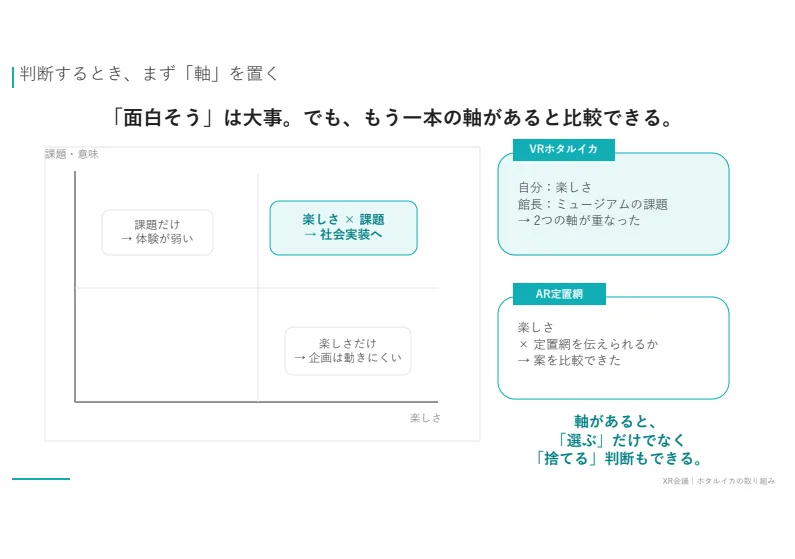
The chosen proposal was an augmented reality (AR) system that would allow users to observe fixed fishing nets. It would be fun for families to see, touch, and enjoy, and would convey how fishermen catch their catches. However, the shift from a racing game to an observation-based AR system created constraints, and only two months remained until the deadline. I was busy with my main job at HoloLab, and with having children, it was a hectic time. I thought it was impossible, but then I questioned the constraints. Was I creating the constraints myself? Was it really something that couldn’t be changed? Was it necessary to do it now? Was it necessary for me to do it? Was I getting too caught up in the means? If I didn’t perceive the constraints as walls but broke them down, there would be gaps. With that in mind, I created some spare time and proceeded with the development.
Ishimura describes himself as an intuitive type. He acts on his intuition when he feels something is right. While the action itself may be good, verification is essential. He continued that people who act on intuition become stronger when they can articulate why they acted the way they did. If you can verbalize your intuition, you can trust your own intuition and act immediately the moment you feel something is right. Instead of tying yourself down by thinking about means and tools, return to your goal, establish a framework, compare, distinguish between what is necessary and unnecessary, and if you decide something is necessary, trust your intuition and act, verify, and move on to the next step. He presented this approach.
For the production of the AR fixed net, we requested supervision from local fishermen through the city, and they actually visited fixed nets and explained the fishing method. We also had the fishermen draw pictures, which we incorporated into the AR. We commissioned a designer friend to create the model for the firefly squid, and even the internal organs were meticulously crafted. If you look closely, you can see the internal organs.
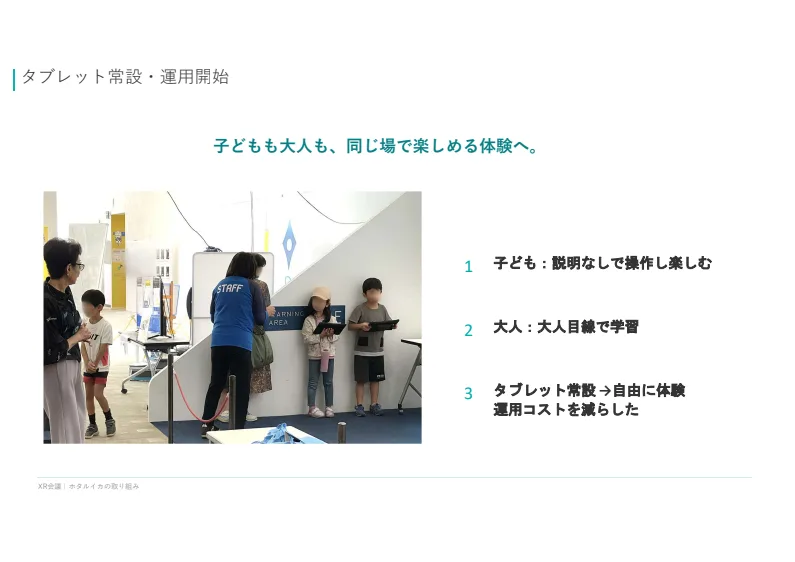
The completed tablets are now on permanent display, allowing children to play without explanation and adults to learn from an adult perspective. Because they can be enjoyed without staff supervision, it has also reduced the operational burden on the museum. Furthermore, taking advantage of their portability, they are being used in SDGs learning in elementary school classes throughout the city. Their role is expanding beyond the confines of the museum to the wider community.
Currently, AR and VR alone are insufficient to attract visitors during the off-season, so they are planning a system that can be enjoyed by a large number of people simultaneously. While acknowledging that the details are still being finalized, Ishimura expressed his personal wish to make the museum a tourist hub, attracting people and encouraging them to visit local shops that have a passion for firefly squid, thereby enriching the entire city of Namerikawa. He also urged visitors to Toyama to experience the VR firefly squid and AR fixed net fishing at the museum, and to enjoy some delicious firefly squid.
Ishimura concluded his speech by saying:
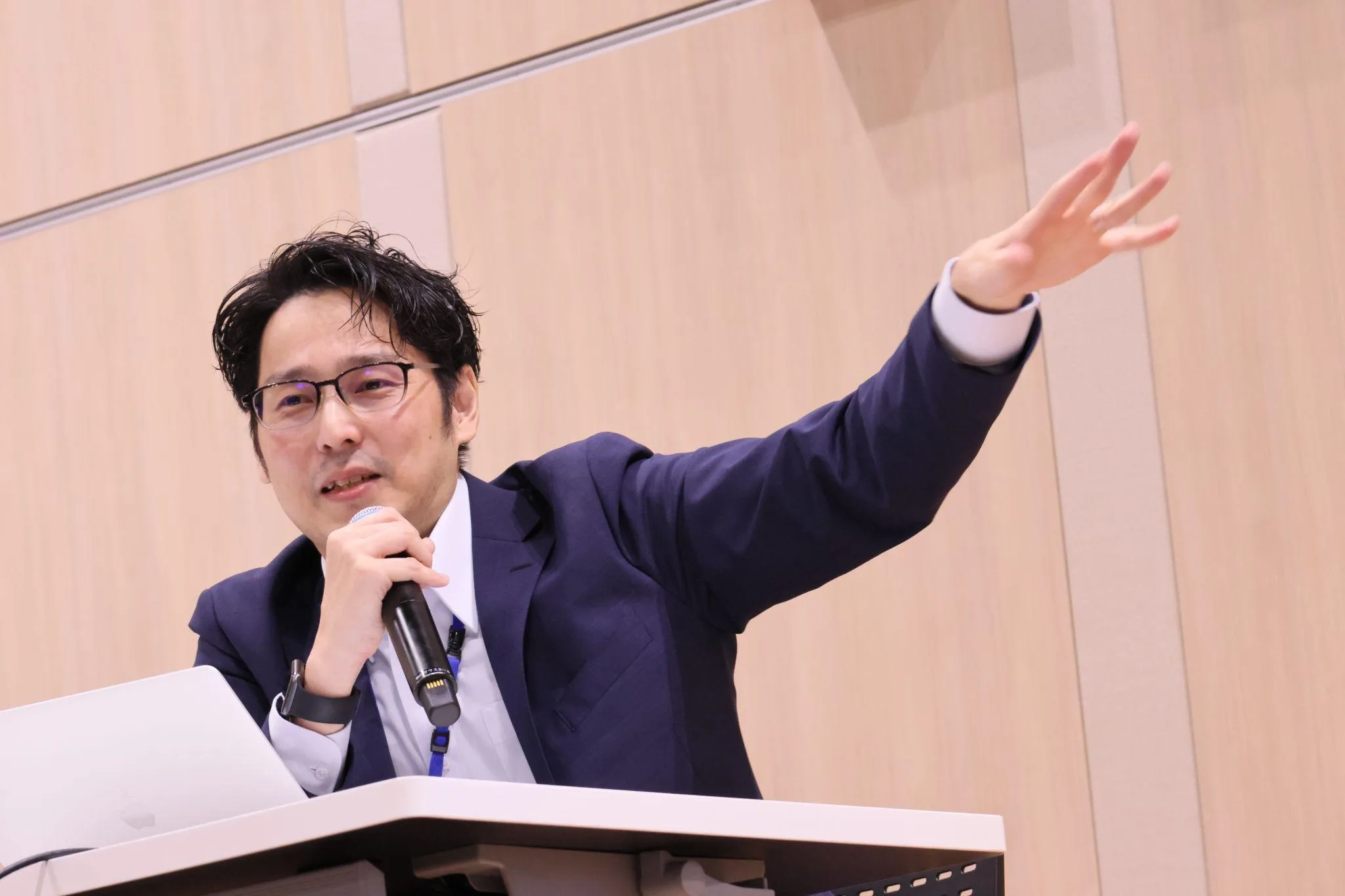
It’s fine to start with your own instincts—that something looks interesting and fun. However, what’s important is what happens next: how seriously you can address the challenges faced by the people you connect with. I want to interact with people who are experimenting in various regions, share information with other regions, and use XR to revitalize local areas.
The latest AI and smart glasses case studies will be showcased at “XR Kaigi 2026,” Japan’s largest conference, held from November 30th to December 2nd.
The XR Executive Kaigi Committee has announced that it will hold the virtual conference “XR Kaigi 2026” for three days from Monday, November 30th to Wednesday, December 2nd, 2026, at Port City Takeshiba (Port Hall, Tokyo Metropolitan Industrial Trade Center Hamamatsucho Building) in Tokyo. Along with the announcement, they have also started accepting applications from sponsoring and exhibiting companies.
*XR Kaigi and MoguraVR are operated by MyDearest Co., Ltd.
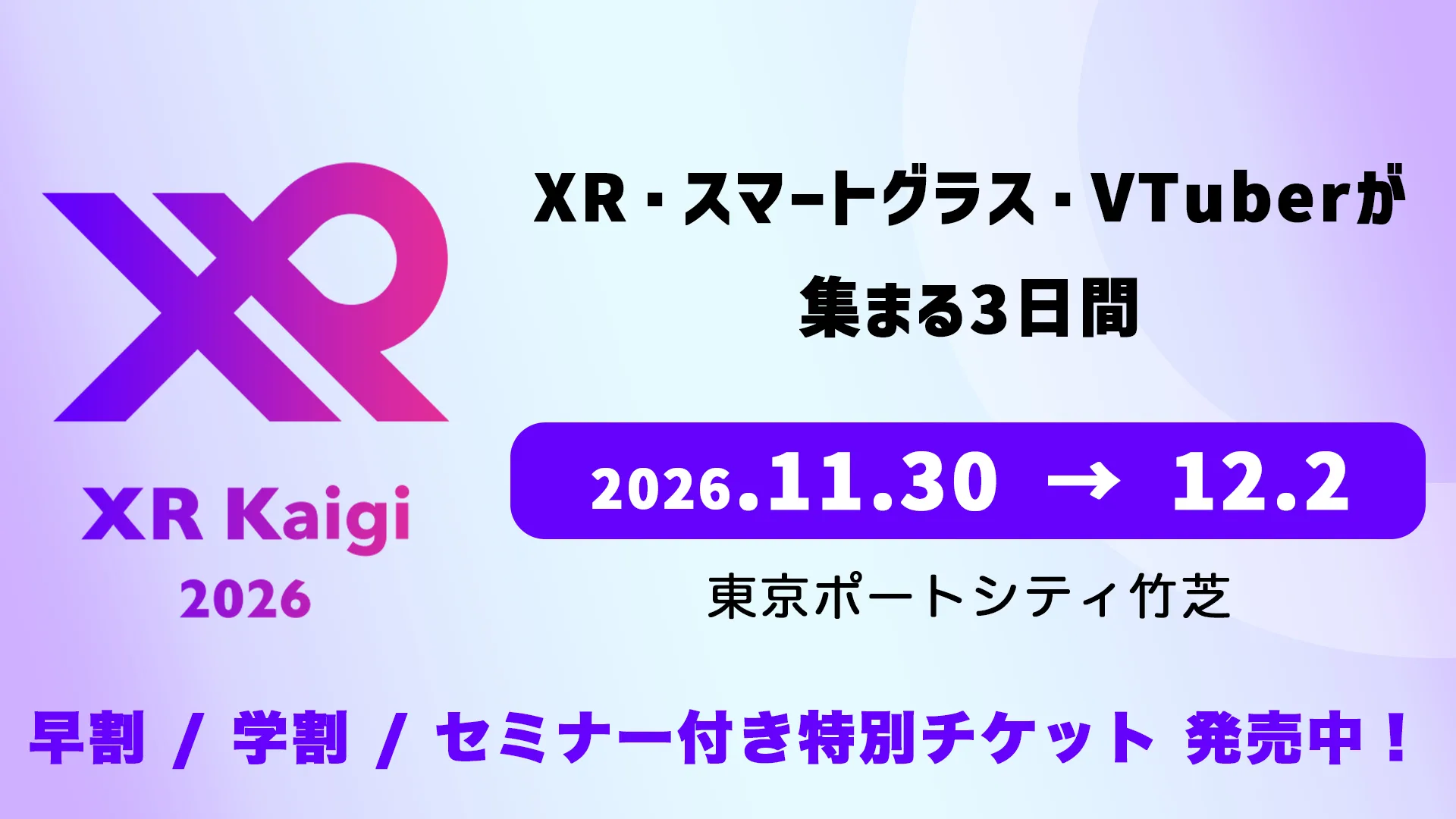
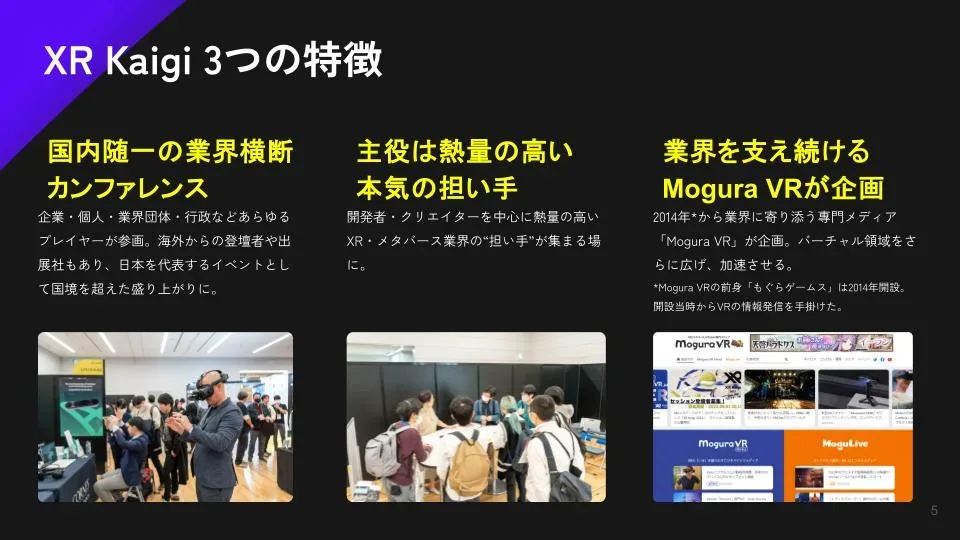
XR Kaigi is a conference for those involved in the virtual realm, including XR, smart glasses, and VTubers. It is a cross-industry event with participation from companies, individuals, industry associations, and government agencies, and will also welcome speakers and exhibitors from overseas. Aiming to be a place where participants, mainly developers and creators, can gather, it is planned by Mogura VR, which has been operating as an industry-specific media since 2014. The expected total attendance is 4,000 people, and the expected number of exhibition booths is 100.
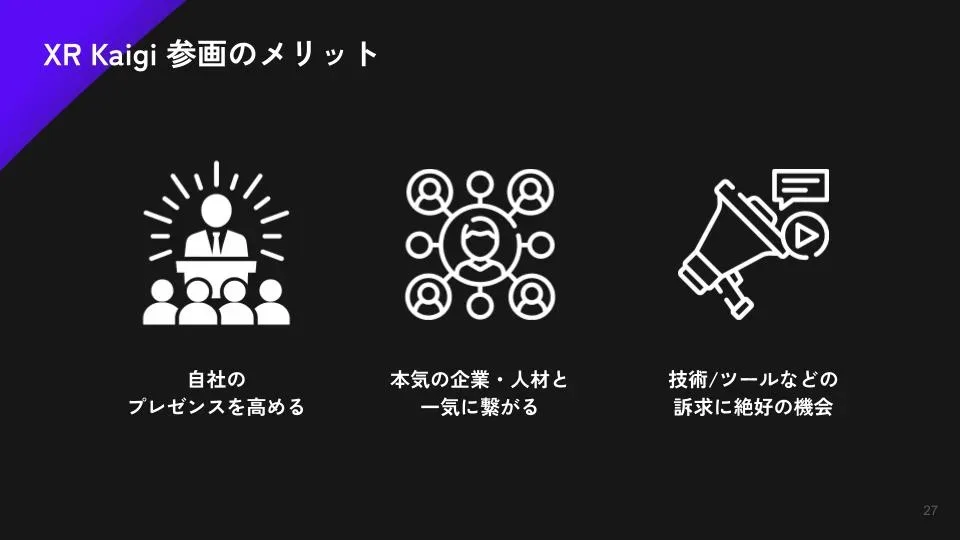
For details on sponsorship and exhibiting, please request information from the official website.
XR Kaigi 2026 Overview
| name | XR Kaigi 2026 |
| Exhibition period | November 30th (Monday) – December 2nd (Wednesday), 2026 |
| venue | Located within Port City Takeshiba (Port Hall, Tokyo Metropolitan Industrial Trade Center Hamamatsucho Building) |
| Estimated total mobilization | 4,000 people |
| Estimated number of exhibition booths | 100 booths |
| Official website | https://mydearestvr.com/xrkaigi/2026/ |
| Organizer | XR Kaigi Executive Committee |