
On April 17, 2026, a new product launch event hosted by jig.jp Co., Ltd. was held in Tokyo. At this event, the full details of “SABERA,” a new AR glasses brand launched by the company, which is based in Sabae City, Fukui Prefecture, were revealed.

Why did jig.jp, known for its software development, enter the hardware market, specifically the AR glasses market? This report details the strategy behind “SABERA Smart Glasses,” born from a joint development with Boston Club Co., Ltd., a long-established eyewear manufacturer in Sabae, and Cellid Co., Ltd., which possesses world-class optical technology, and the next-generation “visual experience” they envision.

(From left: Sho Kawamata, President and CEO of jig.jp Co., Ltd.; Kazumi Komatsubara, President and CEO of Boston Club Co., Ltd.; Satoshi Shiraga, President and CEO of Cellid, Inc.)
The background of “SABERA”‘s creation and its challenge to the market.
At the beginning of the press conference, Sho Kawamata, President and CEO of jig.jp, spoke of their determination to focus on AR glasses as a next-generation information device, leveraging the expertise they have cultivated in the mobile and internet fields for over 20 years since the company’s founding in 2003.

(Kawamata himself wears “SABERA Glasses Smart”)
Kawamata revealed that the background to their entry into the market was their encounter last year with Cellid, the only company in Japan with such optical technology. He said that development proceeded at an unusually rapid pace, with the project being launched just one month later. Kawamata stated, “Considering the functionality and innovativeness of this AR glasses device, as well as the safety provided by Cellid’s advanced technology for plastic lenses, we judged that there is a very high possibility that this device will become widespread.”
On the other hand, there are currently no manufacturers in Japan that provide AR glasses for general consumers. For jig.jp, a software development company, entering the market by handling everything from planning and development to sales in one go is extremely unusual, but Kawamata decided to take on this challenge.
Of course, this would have been difficult for the company alone, and it was only by combining the strengths of three parties: Cellid, which has outstanding optical technology; Boston Club, a leading eyewear manufacturer in Sabae with exceptional design know-how; and jig.jp, which has cultivated software development capabilities.
This rapid development is driven by the recent global growth of smart glasses. Kawamata outlined the situation, stating, “While they are gradually spreading, mainly in the States United and China, they are not yet widely adopted by general consumers. Major players such as China’s Rokid and the States United’ Meta are gaining momentum, and the entry of Google and Apple is also predicted in the future.” He then decided that this timing was necessary to take on the challenge. Amidst fierce competition, SABERA, under the alliance of three Japanese companies, is poised to challenge the competition by leveraging its undeniable Japanese quality, technological capabilities, design, and domestically-focused after-sales service, which set it apart from overseas manufacturers.
A design philosophy that transforms “gadgets” into “everyday tools.”
SABERA’s greatest feature lies in its unwavering pursuit of seamlessly blending into everyday life as “ordinary glasses.” Kawamata explained the reason for calling the product “smart glasses” rather than “smart glasses”: “We wanted to show that it’s not just a cutting-edge gadget, but something that, for some people, could replace regular glasses.” The concept is “Sabae-born smart glasses that quietly refine business and daily life,” aiming for a comfortable fit that doesn’t cause stress in everyday life.

Kazumi Komatsubara, CEO of Club Boston, cited three key aspects of eyewear from the perspective of an eyewear expert: fashionability, comfort, and prescription correction.
Regarding the fashion aspect, they commented, “Since glasses are a fashion item, we adopted the Wellington style, which suits both men and women, and pursued the size and balance to create a design that doesn’t look out of place.”
Regarding comfort, the design incorporates a weight of approximately 40g and a meticulous calculation of the specific gravity balance between the front and temples, resulting in a design that naturally cradles the wearer’s face and prevents it from sliding forward.
Finally, he cited “the ability to insert prescription corrective lenses into the back” as the biggest advantage. “Given that glasses wearers currently make up more than half of the population, compatibility with prescription lenses is essential for everyday use, and we have made this practical by developing a special flat lens in collaboration with a lens manufacturer,” Komatsubara said.
Furthermore, the ability to perform fittings based on specialized knowledge and skills, such as fine-tuning the nose pads, is another strength unique to SABERA, which involves manufacturers from eyewear production regions.

(Komatsubara explains while holding a pair of “SABERA Glasses Smart”)
Boston Club Co., Ltd. has been developing its own brand since 2012 and has previously supplied components and provided expertise on titanium for smart glasses. Sabae, in particular, is excellent at microfabrication of titanium materials, and the company has also provided technical support in welding and surface treatment. These technologies are extensively used in the frames of “SABERA Smart Glasses.”
In terms of optical technology, Satoshi Shiraga, CEO of Cellid, emphasized the importance of “waveguide” technology, a transparent display with a thickness of only about 1 millimeter.

(Shiraga talks about the Waveguide)
The manufacturing of this waveguide requires semiconductor-level nanofabrication technology, despite it being an optical product. The company achieved this processing technology by collaborating with its own engineers and external partners, selecting the necessary equipment, machinery, and materials from scratch. This technology could only be realized in Japan, a country with a high level of concentration in optical materials and semiconductor technology, and it is the heart of SABERA’s ability to combine functionality and comfort.

Launching the domestic market and a roadmap to 100,000 units in three years.
Regarding future business development, Kawamata set a clear goal of “selling 100,000 units in three years.” To achieve this goal, he believes it is necessary to appeal not only to early adopters but also to a wider range of people.

The sales strategy will begin with pre-orders on Makuake starting April 20, 2026, with shipments scheduled to commence sequentially from July onwards. The regular price is 92,400 yen including tax, but Makuake will also offer limited-quantity early bird discount plans. The initial batch is planned to sell 8,500 units, and development and sales will be accelerated in six-month phases thereafter.
Regarding sales channels, e-commerce will be the primary focus initially, but considering the importance of in-store experiences and adjustments, the company intends to establish physical touchpoints such as eyewear stores and electronics retailers by the end of this year. In particular, for prescription lenses, the company will establish a lens selection and delivery process for Makuake purchasers, and aims to eventually provide direct support at physical stores.
The company emphasizes not only the consumer market but also its expansion into the B2B sector. It has already received numerous inquiries from nursing homes, manufacturers, and service companies catering to foreigners, with expectations for its use in supporting on-site work and remote communication. Furthermore, with a view to future global expansion, the company is using the Japanese market as a testbed to build a solid foundation of quality and user feedback, preparing to enter the global market.
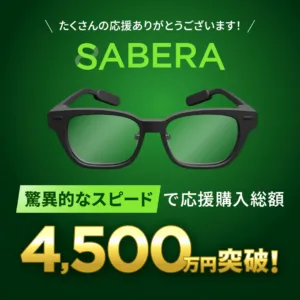
Jig.jp’s Kawamata predicts a future where the widespread adoption of AR glasses will increase the amount of time people have their hands free, reducing the frequency with which they open their smartphones. It has already been announced that the product has surpassed 45 million yen in just 8 hours since its launch on Makuake, indicating a promising start.
Finally, a hands-on experience: The appearance and functionality are sufficient, but the single-eye display is a bit of a concern.
After the press conference, I had the opportunity to try out the actual product. The frame of the “SABERA Smart Glasses” is made of titanium with a rubber coating, and its shape is designed to be easy to use for everyday wear.


The nominal weight is approximately 40g, which is numerically heavier than the nominal weight of its competitor, the “Even G2,” which is 36g (the unit owned by our editorial team weighs 37.7g). However, when actually wearing them, the difference was hardly noticeable. In my opinion, the “SABERA Smart Glasses” felt like they had a better weight balance when held in the hand (I haven’t compared both devices side-by-side, so I would like to re-examine this in the future).
The demonstration tested document display, transcription, real-time translation, and navigation functions, and in all cases, it gave the impression of being on par with the “Even G2.”
Furthermore, the navigation function allows users to display a wide-area map by looking upwards. Although we were unable to experience this feature due to communication environment limitations, it would be an extremely convenient function if put into practical use.
On the other hand, I felt that getting used to the single-eye display would take some time. I’d like to see if I get used to it with continued use.
Crowdfunding information


| Product name | SABERA Smart Glasses |
| Selling price | Regular price SABERA Smart Glasses + Clip-on Sunglasses: ¥99,990 SABERA Smart Glasses: ¥92,400Super early bird price SABERA Smart Glasses + Clip-on Sunglasses: ¥70,990 SABERA Smart Glasses: ¥64,990Early bird price SABERA Smart Glasses: ¥66,990 Makuake exclusive discount price |
| Makuake HP | https://www.makuake.com/project/sabera_smartglass/ |
| Sales period | April 20, 2026 (Monday) 11:00 to June 29, 2026 (Tuesday) 22:00 |
lastly
“SABERA Smart Glasses” have gotten off to a great start, with total crowdfunding exceeding 45 million yen within 8 hours of the start of pre-sales on Makuake.
At this point, the biggest competitor appears to be the “Even G2,” but the “SABERA Smart Glasses” seem to be very close in terms of both functionality and design. This press conference provided an opportunity to learn about the Japanese technology and the developers’ dedication that went into the “SABERA Smart Glasses,” but the actual user experience is a crucial point. When our editorial team gets our hands on a unit, we plan to conduct a thorough review, including battery life.
This article is an English translation of an original Japanese article, translated by the Mogura VR editorial team.
Reference
Materials provided by the other party