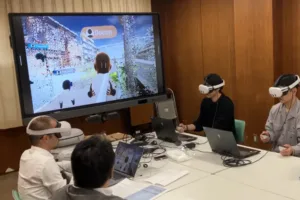
Hanshin Expressway Toll Osaka has introduced VR content for “ETC Bar Restoration Response” as part of its safety training for toll booth staff. It is being used as a training tool, with approximately 800 people experiencing it annually. The development was handled by SUS.

(Screenshot of a VR simulation of an ETC barrier being restored, recreating a toll booth)
The introduction of this system stemmed from the positive feedback received by on-site personnel regarding the previously provided VR content on basic toll booth operations. Further development was undertaken to provide training for more dangerous actual work. The system was built by directly integrating the Hanshin Expressway Toll Osaka safety work manual into the VR training system, creating a training environment that accurately reproduces on-site conditions. This also achieved reductions in development time and costs.

(Enhanced hand tracking capabilities)
One way to improve the quality of training is by enhancing hand tracking technology. This allows trainees to experience actions that closely resemble actual work, such as pressing buttons on touch panels or remote controls directly with their fingers, or moving their fingers along the physical axis of an ETC barrier.

(Instant retry function in case of failure)
Another feature is the instant retry function in case of failure. If you make a mistake in the work procedure, you can immediately check the cause and try again. By repeatedly following the guide and repeating the procedure, you can efficiently learn the correct operation.
SUS Co., Ltd., the developer, states that the development method of integrating on-site manuals into VR leads to reductions in time and cost compared to building from scratch. It is expected to be applied to safety training in various dangerous work environments.
This article is an English translation of an original Japanese article, translated by the Mogura VR editorial team.