
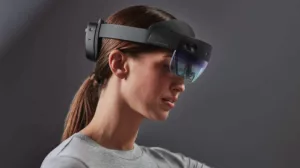
A transparent mixed reality (MR) device that, when worn, allows users to see digital 3D models and information superimposed onto the real world. Microsoft Since announced the first generation HoloLens in 2016, it has been used in industries such as factories, logistics warehouses, and construction. The second generation, HoloLens 2, has appeared as a model with further refined functions for industrial use. Furthermore, it has established a certain market share, with competition including Magic Leap’s Magic Leap 2, which has repeatedly raised massive amounts of funding.
However, as of early 2026, the future of these transparent MR devices is far from bright. Microsoft has ended production of HoloLens 2 and has not provided a concrete roadmap for a successor. Magic Leap has effectively changed its policy, and the opportunities for it to be mentioned as the first choice for industrial applications have drastically decreased. NTT Docomo, the investor and distributor in Japan, also announced in January 2026 that it would discontinue handling Magic Leap devices.
For companies that have been routinely using MR devices in the field, the question of “what should we use next?” is a pressing one. There are moves to repurpose Meta’s Quest series as pass-through MR devices using cameras, but privacy concerns about Meta’s products themselves remain strong, particularly in Europe, so it’s not an option for all companies. There are also voices expressing hope for Google and XREAL’s “Project Aura,” but that is aimed at consumers and is designed as glasses, and even if it is released, it remains to be seen whether it can immediately meet the camera configuration and accuracy standards that HoloLens 2 has achieved.

A gaping hole in the market.
Stepping forward to take on this challenge is HMS Corporation, based in Fukuoka. This company has been providing industrial sensing services centered on AI vision technology, and is planning to launch its AR glasses, “SiNGRAY G2,” which are currently under development, specifically for industrial use.
This time, I had the opportunity to actually try on an engineering sample (equivalent to a beta version) of the SiNGRAY G2 at HMS’s office in Fukuoka and hear directly from the development team. It features a Sony microOLED display combined with a Qualcomm QCS8550 and Intel Myriad X VPU, and an MRTK-based SDK that makes it easy for HoloLens developers to transition to. The numbers on the spec sheet are ambitious.
So, what about the actual device?
Please note that this article covers the beta version as of January 2026, and the weight, design, and software may all change in the final product. Please read this as a report documenting the current state of development.
My first impression upon holding it: “Industrial-grade robustness.”
When I first saw the SiNGRAY G2 on the table, my immediate reaction was, “Wow, it’s big.” The goggle-shaped body has a battery unit that protrudes from the back of the head, giving the overall impression of being a slightly thicker version of the HoloLens 2. The casing is a combination of aluminum and plastic, and when you pick it up, you can feel the cool touch of the metal parts.

However, the current body is merely an engineering sample. As the development team member added, “It’s still planned to be smaller,” and each part is currently being slimmed down for the production version. In fact, there are voices within HMS saying that “this design can be improved further,” and the person in charge himself said with a wry smile, “I want to make it a little more stylish.”
Regarding weight, with the battery included, it exceeds 700g, making it feel quite heavy when held in one hand. For comparison, the HoloLens 2 weighs approximately 566g. When placed on the head, the forward pressure is somewhat noticeable. Further trial and error in the front-to-back balance design will likely be necessary to ensure that many people can wear it comfortably for extended periods.
At this point, the representative prompted me to “try removing the battery.” The SiNGRAY G2 has a replaceable battery. Removing the battery at the back of the head while still wearing the headphones completely changed the impression. “Wow, it’s completely different,” I exclaimed. I could feel that the battery accounts for a significant portion of the weight. Optimizing the battery design is one of the top priorities for the final product. The processor board and controller board in the main unit also have considerable weight, so a dramatic reduction in weight may be difficult, but even just improving the battery area should significantly change the wearing experience.
High-brightness capabilities that make it suitable for outdoor use.
The SiNGRAY G2’s optics employ the same BirdBath system as XREAL’s glasses-type displays. Its diagonal field of view is 51 degrees, numerically almost identical to HoloLens 2. Because it also displays a wide vertical field of view, it’s comparable in quality.

On the other hand, the image quality itself is striking. The Sony Micro OLED 1920×1200 dual display boasts a contrast ratio of 100,000:1 and a PPD (Pixels Per Degree) of 43. The display under indoor lighting is sharp and the colors are deep.
A distinctive feature is the electrochromic photochromic lens. The degree to which external light is blocked can be changed with the push of a button, but the change in brightness is slow, and a faint mechanical sound can be heard when switching between settings.


A key feature is its high brightness, which allows for a very clear display indoors. I then turned on the dimming function and set the transmittance to the lowest setting, and tried going outside via the emergency staircase. The day I tested it was cloudy, but the dimming function seemed to work well, as long as I didn’t look in the direction of the sun, which would have been the whitened area. On the other hand, if you plan to use it mainly outdoors, you will need to check how it looks in bright, direct sunlight under conditions closer to real-world environments.

6DoF tracking accuracy
The SiNGRAY G2’s brain is comprised of a Qualcomm QCS8550 (equivalent to Snapdragon 8 Gen 2) and an Intel Movidius Myriad X VPU. This heterogeneous configuration, with the main SoC handling general-purpose processing and the VPU handling vision-based inference, aims to achieve both the high-precision spatial recognition and application execution required for industrial applications.
The 6DoF SLAM operates at 100Hz. Spatial recognition in indoor environments worked in real time, reliably capturing tables and walls. Hand tracking recognized all 10 fingers and responded to even the smallest finger movements, such as typing on a keyboard.
The main issue is heat generation. After wearing it for a while, the device clearly gets hot. The person in charge acknowledges that “there’s a trade-off in how much we can reduce the CPU load,” and that they are currently working on optimization. Finding the right balance between processing power and thermal design will be a key point for the final product.

Designing to prevent downtime on-site: The practical application of hot-swapping and 3-minute exchanges.
For industrial devices, battery operation is a matter of life and death. Can it last through an entire factory shift? Does it keep operations running smoothly every time the battery needs to be replaced? What the factory floor needs is a system that doesn’t shut down, rather than just the capacity listed on the spec sheet.
The SiNGRAY G2’s battery is 7.6V/2500mAh. Looking at the capacity alone, it’s not particularly large. Due to heat generation, there are limits to the continuous usage time. That’s why HMS is focusing on hot-swapping, which allows you to replace the battery while the power is on and the device is still installed.

I was shown a demonstration of the replacement process. With the wearer still wearing the goggles, they slid out the battery unit at the back of their head and inserted the charged unit. It was over in an instant, taking less than 10 seconds. Apparently, with the previous generation SiNGRAY, it was necessary to turn off the power before replacing the battery, so this is a clear improvement.

(The one on the right is the previous generation model)
The battery unit comes with a dedicated charger. The design is likely based on the assumption that multiple batteries will be used in rotation for charging. Minimizing the number of swaps, and thus maximizing the operating time of each battery, is a key development point, along with optimizing thermal control.
In addition, it boasts IP65 dust and water resistance and a robust design intended for use in factory floors and fieldwork. Connectivity includes BT 5.2, Wi-Fi 6, and GPS. It also features a stereo speaker/mic for voice control, but this was not tested during this review.
Aiming to be “the next HoloLens” with an MRTK-compatible SDK
The development environment for SiNGRAY G2 is a combination of the SnapDragon Spaces SDK and the Unity Native SDK (MRTK-based). This configuration is clearly designed with the transition from HoloLens 2 in mind. For developers familiar with HoloLens 2, the design philosophy is to allow them to port their applications with relatively low barriers while leveraging existing assets.
The next challenge is OpenXR compliance testing. The certification process for EVT in the first half of 2026 is on the horizon.
Tailwinds in Europe and emerging business opportunities
In the industrial MR device market, HMS’s competition is decreasing. This seems to be quietly giving them a sense of accomplishment. This unexpectedly created market void is attracting inquiries from all over the world to this small Fukuoka company.
Europe, in particular, is seeing a lot of activity. Many companies are hesitant to adopt Quest for industrial use due to persistent privacy concerns regarding Meta products. Pico, a subsidiary of China’s ByteDance, is also being avoided for similar reasons. According to a representative, inquiries from European distributors have recently surged.

On the other hand, due to semiconductor supply issues and the production costs of Micro OLEDs, the perception was that the widespread adoption of consumer AR glasses “was less likely than it once was, within the next one or two years.” Conversely, this means there is time to steadily build a track record by specializing in industrial applications. When this window closes will be the crucial moment for HMS.
Can the SiNGRAY G2 become the “legitimate successor to HoloLens”?
The SiNGRAY G2 is a product that directly addresses a vacant market segment. It aims to serve as a migration destination for HoloLens users with its MRTK-based development environment, meet the needs of field operations with hot-swapping and dustproof/waterproof features, and ensure the visibility required for industrial applications with the high-definition imagery of SONY Micro OLED. Its target is precise.
The next milestone is the first half of June 2026. The plan is to gradually begin small-scale production and conduct joint testing with partner companies.
I’m looking forward to seeing how much it has evolved the next time I get to use the actual device. It’s a device I’ll continue to follow closely.