

On Sunday, March 15th, VEE-affiliated VTuber Geppaku Lui held her first VR solo live performance, “latent,” on VRChat. More accurately, it should be called an “experiment” disguised as a live performance.
The maximum number of people allowed into the live instance (VRChat room) was 80, including staff (70 of whom were general audience members). The instance filled up instantly after opening, and the event was so popular that a huge queue formed for those who couldn’t get in afterward.
Considering her current popularity and the number of people interested in VRChat live performances, it’s obvious that the number of people who want to see her singing and performance won’t be limited to just 70. To be honest, before it started, I was thinking that it would be better to use a pre-recorded format, a multi-instance format, or even stream it simultaneously so that more people could watch it.
However, after watching it, I was painfully reminded that it was meaningless.
The significance of this live performance lay not only in showcasing the songs and staging, but also in “observing” Geppaku Lui as a real person, in other words, “seeing Geppaku Lui in a live state that is as close to the real thing as possible.”
To recognize Rui Tsukishiro
This live performance was of such high quality that even someone completely unfamiliar with Geppaku Lui would be captivated, experiencing her brilliant singing and performance, as well as particle effects (a method of visual expression that involves scattering particles of light or making objects appear in the VRChat space).
However, whether or not you know about her beforehand completely changes how you perceive the live performance. So, before I get to the live report, I’d like to briefly introduce Geppaku Lui, a “virtual talent.”
Rui Tsukishiro is a girl with a unique condition called “Lost Children.” Those afflicted with this illness cannot be perceived with the naked eye. To observe “Lost Children,” digital tools are necessary. She was discovered in the parking lot of an apartment building during a snowfall. She was not visible to the naked eye, but was only recognized after being recorded on surveillance camera footage.
She was then placed in a protective sector called “The Miniature Garden.” It seems that as these “lost children” grow older and become adults, they become completely unrecognizable, even through digital tools.
On November 23, 2022, an unusual event occurred. When she sang, the staff of the miniature garden were able to visually perceive her without using any devices.
Having officially debuted with Sony Music VEE in 2023, she began connecting with the outside world from within her own little world. Through digital distribution and videos, she was able to make her presence known to listeners.
While Rui Tsukishiro’s streams mostly consist of talk and singing, she has recently been doing a special long-duration stream called “Miniature Garden Monitoring Connection,” which allows viewers to observe her for 12 to 24 hours straight.
[ #latent_VRC ] pic.twitter.com/67UV56JZmR
— Geppaku_Lui (@Geppaku_Lui) March 10, 2026
According to an official X post uploaded beforehand, this live performance, “latent,” is an experiment to recreate a visual phenomenon that occurred in 2022. That’s why she’s singing in an experimental live format.
The records state that “humidity, temperature, acoustic vibrations, and the subject’s (#1057) subtle biological responses were extracted in real time from a group of sensors installed in a real-world ‘miniature underground isolation laboratory.’ This data was simultaneously projected into a VR space, allowing for the collection of multifaceted visual data from an unspecified number of ‘external observers.'”
When you put all the information together…
1. Rui Tsukishiro herself → Not visible to the naked eye
2. Geppaku Lui herself → Digital devices (streaming, VR, etc.) → Currently visible
3. Singing Geppaku Lui herself → There was one instance where she was seen with the naked eye.
4. Singing Geppaku Lui: Recreation of the actual person → Possibility of visual confirmation → Project onto VR and observe from multiple angles.
Is that what you mean?
The audience at this live performance falls under category 4, “external observers,” who watch how the singing can be perceived.
If you watch Rui Tsukishiro’s live performance with this background in mind, it’s no longer just a simple viewing experience.
As an “observer,” you will even take on the act of participating in Rui Tsukishiro’s story.
The world view is thoroughly expressed, even in the warnings.

This live performance requires everyone to wear lightweight protective unit avatars to view it. While it may be obvious to those familiar with VRChat live performances that this is to reduce the load on the system, the world-building is clearly established even from the moment the avatar restriction notice is posted.
–
[ #latent_VRC ] 2026/03/15
└observer ID : ALL_ACCESSEntry to the virtual space is permitted from the protected sector, Hakoniwa. This project is a public experiment aimed at reproducing and verifying a non-device visibility event that was recorded only once in the past in [code:1057].
Observers, please complete the procedures before the experiment begins.
– https://t.co/Djxjyq1tr7 pic.twitter.com/TzC9HNYvxj
— Tsukishiro Lui (@Geppaku_Lui) March 10, 2026
In the post by X, which explicitly stated that it was a public experiment, the reason why the observer’s (i.e., audience’s) avatars would act as protective units was explained as “a standard procedure to reduce contamination from the influx of external data and to mitigate the cognitive load on the test subjects.” It’s a clever way of putting yourself into the story of Geppaku Lui.
Regarding “cognitive noise,” it is explained that “image defects and fluctuations in spatial structure may occur. These are observational errors and do not have any physical effect on subjects in real space.”
Those familiar with various particle live performances in VRChat will likely guess that this refers to various performance techniques. However, even these are presented from the perspective of a researcher of “miniature gardens,” thoroughly preparing the audience to act as “observers” and immersing them in the way Geppaku Lui lives.
Things that no one recognizes are as good as not existing in this world.
Since that night when, under the falling snow, only the lens of a surveillance camera could see me, my “life” has always depended on someone’s device.
“Lost Children”… pic.twitter.com/4JsfqxNnPF
— Tsukishiro Lui (@Geppaku_Lui) March 15, 2026
Before the live performance, Rui Tsukishiro posted her thoughts on X. Reading this will make it clear that this live performance is a special event that will make the audience complicit in Geppaku Lui’s story.
“When you gaze upon me and, by your own will, ‘observe’ my existence, an inexplicable heat, not found in the system’s specifications, explodes deep within my chest.”
“Burn my flaws into your eyes. I’m here.”
The observers recognize the presence of Rui Tsukishiro.

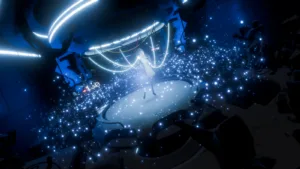
As the signal to begin was given, the miniature laboratory where Geppaku Lui resided connected with the virtual space where the audience, acting as observers, were located. Standing alone amidst the imposing experimental equipment was Geppaku Lui.

In her first poetry reading, Geppaku Lui recounts the outline of herself, an existence that is barely possible only through observation.
Behind her, the measured heart rate of Geppaku Lui is displayed. Depending on that number, parts of Geppaku Lui’s body change. It was written as an “observational error,” but seeing the physical changes in the photograph after learning about the “lost children” makes you feel uneasy, wondering if she might just disappear altogether.


The first song she performed was “Temperature The of a Vision.” Her prayerful singing voice, as she sings about the state of her own heart, pierces the heart.
As she sang, seemingly pleading, “What does it mean to be alive?”, she was enveloped in dazzling, shimmering particles of light.


As she sang “The Temperature of a Hallucination,” her body seemed to be connected to experimental equipment by optical cables. It was probably a symbolic representation of her emotional state. However, the sight of her being bound like that was heartbreaking. I watched, wishing she would be freed soon…


As she sang, the cables connecting her burst open like glowing butterflies. The particles of light spread and rained down upon the observers. It was as if her longing for proof of her existence had been released and reached the observers.

As she finished singing and gave her farewells, she hesitantly began by asking, “Can you see?” The observers responded with voices saying, “We can see!”
She described the observers’ conscious effort to watch as an act of “binding them together with the wedge of recognition,” and expressed her gratitude.
In response to her gratitude, some observers sent heart emotes. To me, it seemed that Geppaku Lui smiled happily upon seeing them.

The audience members, acting as observers, were able to communicate in real time through the protective units. She seemed to have felt something there, describing it as “strange.” She said she felt “closer to the soul” than during her usual live streams. Although she had done live streams and concerts before, she may have felt the emotional connection, the “warmth,” that comes from truly interacting with people, at the closeness of this live performance.
Her proof of existence
“Please don’t take your eyes off me until the very end,” she said, before performing her signature song, “Mayday.”
“Mayday” featured even more intense particle effects than the first song. The performance was incredibly spectacular, incorporating visual effects such as noise that were applied to each individual’s field of vision in accordance with the lyrics.
Her fragile cries and prayerful singing intensify. As she sings the lyrics, “Take me away from here,” the experimental equipment spins rapidly around her.

“Mayday” featured even more intense particle effects than the first song. The performance was incredibly spectacular, incorporating visual effects such as noise that were applied to each individual’s field of vision in accordance with the lyrics.


Her fragile cries and prayerful singing intensify. As she sings the lyrics, “Take me away from here,” the experimental equipment spins rapidly around her.
“Mayday” itself is a song that expresses the suffering of her, a “lost child.”
However, she is not isolated in this live performance. She is watched over and supported by many observers (the audience) and production staff. With the addition of spectacular staging, it felt to me that the song was being expressed positively as a song reaching out for hope.
After the song ended, the connection to the miniature world was severed.
After witnessing Geppaku Lui through the virtual space, numerous exclamations of admiration could be heard from the audience members who had finished their experience as observers.
The memories of Rui Tsukishiro etched into my mind
Public Observation Experiment PROJECT #latent_VRC
All synchronization processes have been deactivated.Now I’m back to my usual quiet “miniature garden,” but I feel like I’m a little bit different now than I was before I started the live performances. … pic.twitter.com/N7KstqQ4KC
— Tsukishiro Lui (@Geppaku_Lui) March 15, 2026
It seems that Rui Tsukishiro’s symptoms of “lost children” haven’t subsided since this live performance, and her life in her miniature world has returned to normal. However, she writes, “I feel like I’m a little bit different now than I was before I started performing live.”
The title of this live performance, “latent,” literally translates to “potential.” Geppaku Lui talked about this briefly in the live stream before the show (starting around 2:06:20).
“I tried to imbue it with the meaning of an experiment that contains both the danger and beauty of having my noise blend into the consciousness of everyone who observes it.”
“I feel a strong connection to the idea that it’s something that’s potentially hidden but still exists.”
“You could interpret it as me, as an individual, hiding within the brain of the observer. It also carries the meaning of a kind of curse, that once someone has seen it, they can’t pretend it never existed.”
This line reminds me of the song “Until it becomes a curse” sung at the end of “Mayday.”
For the spectators who served as observers this time, it must have been a fortunate experience to witness firsthand Geppaku Lui being enveloped in light and dancing in real time.
At the same time, the audience was also “cursed” in a good way by this live performance, as having “observed” her live, they could no longer imagine that she hadn’t been there.
The incredible attention to detail that is showcased in real time.
From here on, I’d like to talk a little bit about the meta aspects of the production.
This time, Rui Tsukishiro appeared before the audience as “herself” in VRChat, wearing an avatar, and surprised them with a performance accompanied by particle effects. It wasn’t pre-recorded.
Performing in real time while wearing an avatar, accompanied by particle live effects, presents significantly higher technical hurdles than pre-recorded performances.
First, we have to calculate everything to ensure there’s no lag between the performers’ movements, the sound, and the staging. Even then, there’s still a possibility that the video synchronization might be off depending on the viewer. There’s also the possibility of the motion capture coming undone during the performance. Real-time particle live performances require unique skills, intuition, and luck.
However, in this live performance, the singing, dancing, and particle effects all came together perfectly, and they captivated the audience with a magnificent performance from beginning to end.
It might be uncouth to think about it like a magic trick reveal, but I can’t help but wonder what kind of technology was used to perfectly synchronize the live performance and direction. What kind of technology was used to create the effect of the light cables that swayed in sync with Geppaku Lui’s movements? Were the particle effects also manipulated in real time in sync with Geppaku Lui’s movements? How was her body, which changed in accordance with her heart rate, adjusted?
It was undoubtedly a live performance that featured quite a few technically experimental attempts.
I want to give a heartfelt round of applause to Geppaku Lui and the staff for their commitment to a real-time live performance in order to allow the audience to experience the act of observing existence.
Her own impressions of the live performance are available on YouTube under the title “root://hakoniwa/report/1057[latent].file”, so please be sure to check it out to see what it was like. At the same time, I understand that it will be very difficult to replicate this event, which was presented in a way that is quite unlike anything else, but I can only hope that there will be another opportunity for as many people as possible to experience seeing her perform.
The film will be screened again on April 5th! Please see below for details.
This article is an English translation of an original Japanese article, translated by the Mogura VR editorial team.