
The results of a joint research project between GMO Pepabo’s Pepabo Research Institute and the Ohta Laboratory at Yokohama National University have been accepted for publication in the international academic journal “Advanced Intelligent Systems.” The paper, published on June 9, 2026, details a wearable, soft EMG device (EMG: a technology that records weak electrical signals generated when muscles move) that recognizes speech without the user speaking.

Traditionally, voice input using devices has faced challenges such as privacy concerns due to the potential for spoken content to be overheard and decreased recognition accuracy in noisy environments. Research into “Silent Speech Recognition (SSR)” to address these issues has been ongoing for some time, but it requires the constant attachment of sensors to the face or mouth, which has presented challenges in terms of appearance and wearing burden.
The newly developed device is worn on the hand, and the electrodes on the fingertips are brought close to the mouth only when needed to acquire electromyographic signals. Even when a person is not speaking, the muscles around the mouth move slightly when they are about to speak. The device picks up these weak electrical signals and uses deep learning to identify words. Liquid metal wiring is used to follow the movement of the fingers, and a transparent, flexible material is used for the electrodes that touch the mouth. The entire device is encased in a soft elastomer, creating a structure that does not hinder the natural movement of the fingers.

Overview of this research and prototype device (a wearable, flexible EMG interface).
Analysis using a deep learning model successfully identified 30 words with an average accuracy of 97.2 ± 1.3%. Furthermore, it was demonstrated that the drone can be controlled in real time using only silent commands. This shows its potential to function as an alternative input method to voice, even in noisy environments or situations where privacy concerns are important.
Pepabo Research Institute explained that it will now widely disseminate its findings to researchers and companies in the medical, welfare, and wearable AI fields, aiming for practical application.
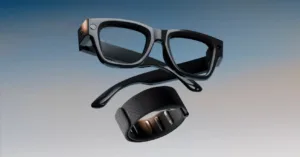
Beyond the research mentioned above, the use of wrist-worn EMG devices is expanding at the corporate level. Meta is developing the “Meta Neural Band,” a wristband-type controller designed to be used in conjunction with the “Ray Meta-Display Ban” AI glasses announced in September 2025. This allows users to control the glasses’ apps with hand gestures, and an early access program for “EMG Handwriting,” which allows users to write messages on any surface with their fingertips, has also begun. In joint research with the University of Utah, Meta is also advancing applications such as smart home control and disability support using wrist electromyography.

This article is an English translation of an original Japanese article, translated by the Mogura VR editorial team.
Reference
Pepabo Research Institute News