On August 18, 2026, IZUTSUYA Co., Ltd. released the web service “3DGS Mesh Converter” in beta. 3D Gaussian splatting (hereinafter 3DGS) is a technology that reproduces the appearance of reality as a collection of points from multiple photographs. This service can convert .ply files taken with 3DGS into meshes, a common data format that represents 3D shapes as a collection of surfaces.
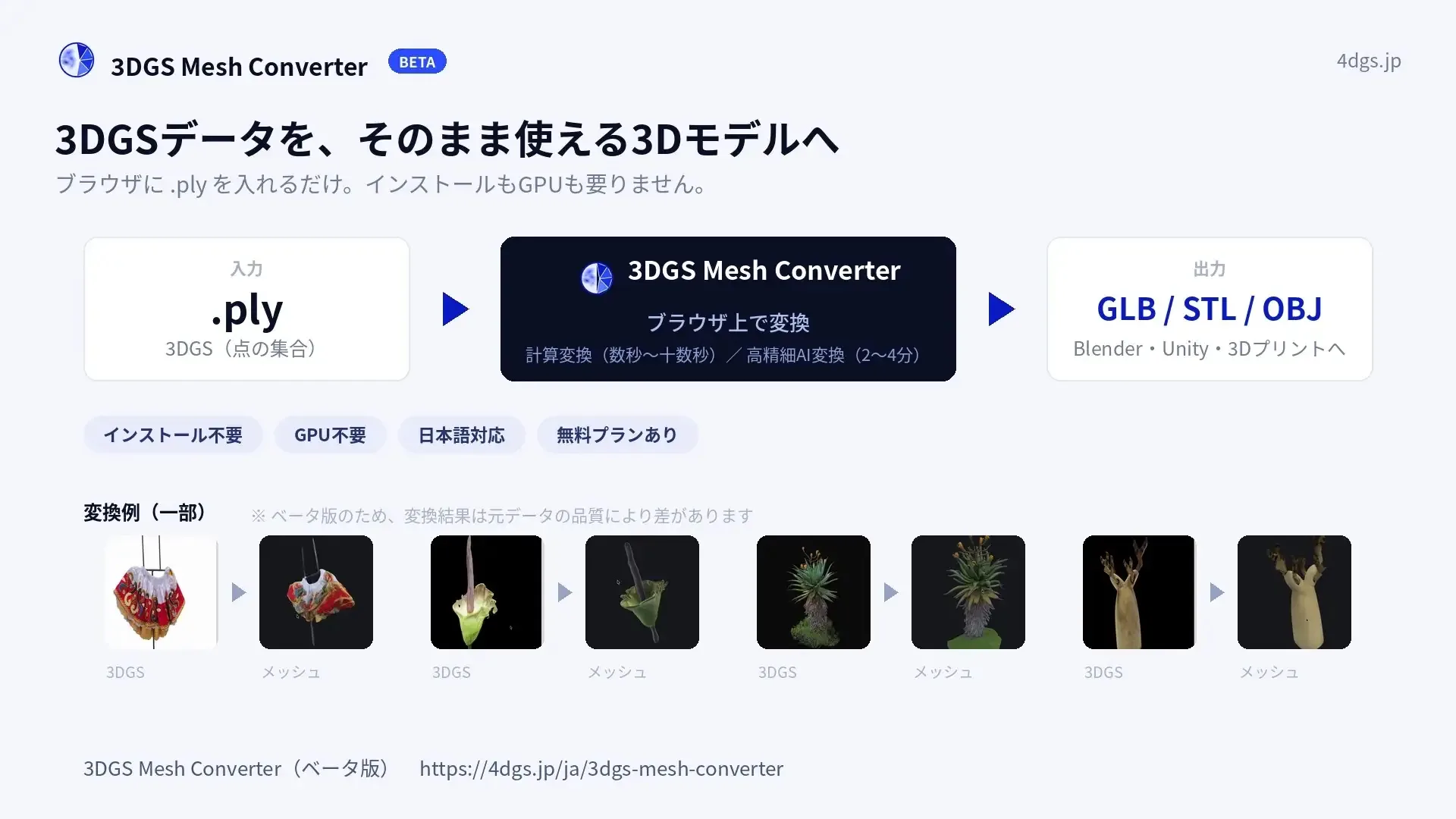
Using it is a simple three-step process. Just drag and drop your .ply file into your browser, select a conversion method, and download the resulting mesh. Uploadable files are limited to 500MB. No special software installation or a PC with a dedicated GPU is required. Processing is handled on the company’s servers, so it can be used from a laptop while on the go. A free plan is also available.
There are three export formats: GLB (which includes color and texture), STL (for 3D printing), and OBJ (for existing workflows). This allows you to directly use the converted data in Blender, Unity, 3D printers, and other applications.
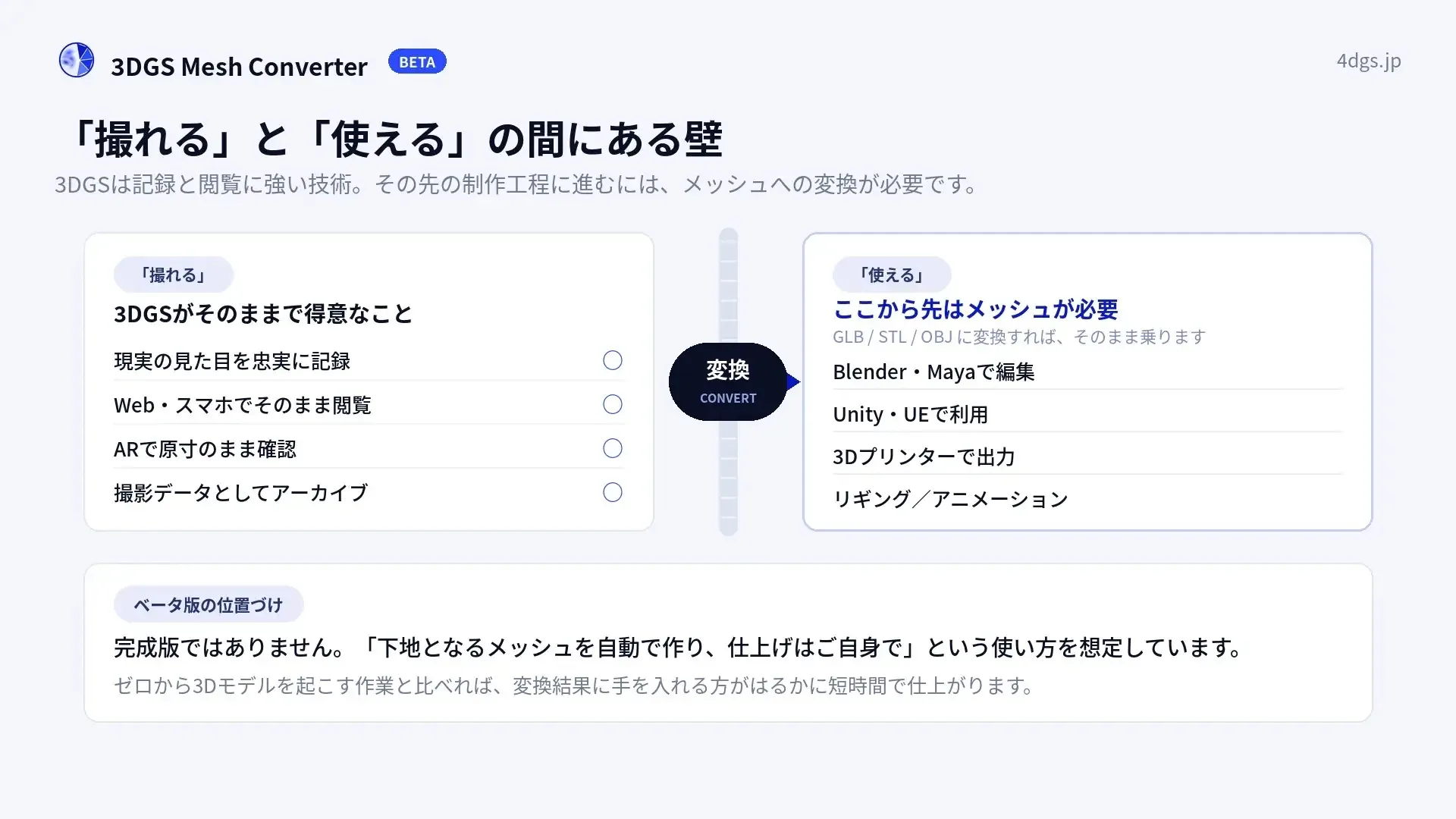
The background to this service is the barrier between “capturing” and “using” 3DGS data. 3DGS data is a collection of points (Gaussian), not a conventional 3D model. As a result, it is difficult to proceed to processes such as editing, use in games, and 3D printing, and the company says it has repeatedly received inquiries from people who want to print it with a 3D printer. Therefore, in order to take the lead in mesh generation with 3DGS and promote 3D workflows throughout the industry, they have decided to release a beta version.
There are two conversion methods to choose from depending on your purpose. The first is computational conversion, which geometrically generates the shape from the distribution of points in the original data. Because it doesn’t use generation AI, it’s faithful to the original shape. It’s suitable for applications where accuracy is crucial, such as measurement and recording. The process takes a few seconds to over ten seconds. However, the company explains that accuracy remains a challenge. The other method, high-resolution AI conversion, involves rendering 3DGS from four directions and passing the images to an AI model, generating a mesh while supplementing details. This takes approximately 2 to 4 minutes. Because AI correction is involved, some modifications may occur from the original data.
After conversion, you can view the results in a 3D viewer in your browser, and the original 3DGS thumbnail will be displayed alongside it. This allows you to judge the final result before downloading. Past conversion results are saved to your account and can be re-downloaded at any time from your history.
Furthermore, the company offers a free 3D/4D point cloud data viewer and platform at 4DGS.JP.
“3DGS Mesh Converter” Service Overview
| Service Name | 3DGS Mesh Converter |
| offer | IZUTSUYA Co., Ltd. |
| Release date | August 18, 2026 (Beta version) |
| Input format | .ply(〜500MB) |
| Output format | GLB/STL/OBJ |
| Conversion method | Calculation conversion (several seconds to over ten seconds) / High-resolution AI conversion (approximately 2 to 4 minutes) |
| Fee | Free plan available |
| URL | https://4dgs.jp/ja/3dgs-mesh-converter |
This article is an English translation of an original Japanese article, translated by the Mogura VR editorial team.